


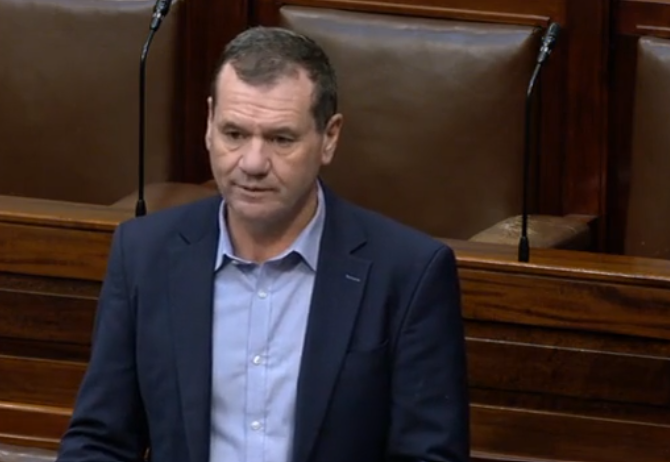
Sinn Féin TD Paul Donnelly has said that the government should work more closely with the EnergyCloud scheme.
The not-for-profit organisation takes surplus renewable energy and redistributes it into the electrical grid.
The organisation has received funding from Amazon, and is already co-operating with Galway and Offaly County Council, and is currently working with Fingal County Council on providing energy to 500 households.
Donnelly said that, at a time of high electricity costs for consumers, the government should be looking at solutions to ease pain for households.
Speaking in the Dáil last week, the Dublin West TD noted that the Programme for Government, drafted in January 2025, includes a “commitment to use surplus renewable energy to help those in fuel energy poverty.”
Figures from EnergyCloud showed that energy wastage came to 2,137 GWh, which translates to €756 million.
“It is equivalent to 692 million tanks of hot water heated. The average waste per day is €1.633 million. That is energy that is being created every single day that is going to waste,” he said.
“EnergyCloud is trying to make the connection between the renewable energy that is being created, which cannot be used at a particular time that day, and people who are in energy poverty.”
“When we talk about the cost-of-living crisis that we have at the moment, there are something like 320,000 people currently in energy poverty or energy debt. They are a number of months behind on their payments. The scale of this is absolutely huge. The scale of energy that is being created and wasted is astonishing,” Donnelly stated.
The Sinn Féin TD noted, “I know we are in June, but we are not talking about warm weather today. I welcome the report but there needs to be more urgency about it. People are choosing between heating and eating need it now, and they need that support now.”
In response, junior minister Noel Grealish said the Department of Climate, Energy and the Environment commissioned a report about energy usage.
The Minister noted that the government’s national energy demand strategy aims to make 20% to 30% of electricity demand flexible by 2030.
“A key aspect of this strategy is preparing households and businesses to maximise their use of renewables,” he explained.
Grealish further noted, “we are advancing the development of district heating systems to take excess heat from large energy users and other sources to power district heating solutions for both households and businesses.”
While welcoming some government progress on the issue, Donnelly said, “I welcome the report, but there needs to be more urgency about it,” and said that more needs to be done to make sure the government recommendations make it into the Budget process.”