


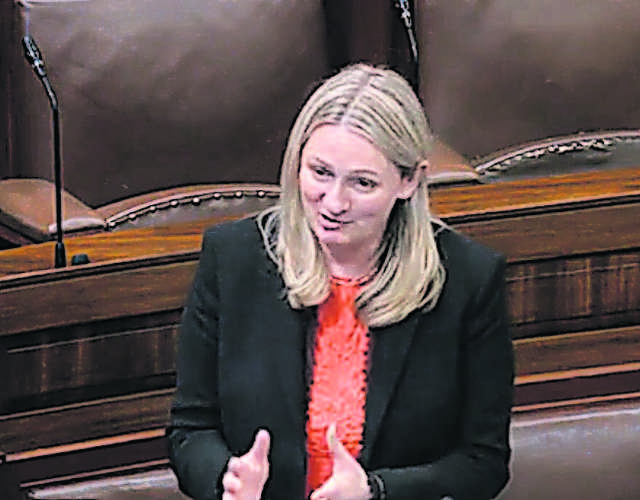
Fine Gael TD Emer Currie has said that middle-income workers need support in October’s Budget.
Last October’s Budget and emergency cost-of-living payments introduced by the government following the beginning of the war in Iran had little for PAYE workers.
Fine Gael has been making overtures towards the PAYE cohort in recent weeks (with Tánaiste and Minister for Finance Simon Harris looking to make it easier for middle-income workers to set up investment accounts), but Currie said that concrete plans were needed, and not just policy proposals.
Speaking in the Dáil, Currie said that working families face what she calls a “struggle to juggle.”
“Working families are under pressure; they feel like they are often chasing their tails and that there is not enough at the end of the month to show for all their hard work. It is what I have always described as the struggle to juggle,” she said.
Currie noted that Fine Gael has “consistently supported working families over the years,” but there was a sense that the government could be doing more.
“The Tánaiste and others have said this budget will include income tax changes, which I welcome because those families deserve to get more back based on what they are putting in.”
The Tánaiste said that he was “not an ideologue” on the issue of personal taxation, and noted that last October’s Budget was the first of a planned five over this government’s lifetime.
He noted that the coalition agreement, signed in January 2025, was also committed to implementing “progressive” changes to taxation, but only in the event the economy remains “strong.”
The language in the coalition agreement gives the government wriggle room to potentially backtrack; this week, the Central Statistics Office noted a 12.1% decrease in GDP for the first three months of this year, while the domestic economy grew by 0.6%.
Global economic uncertainty may end up putting Fine Gael’s plans to help middle-income families on hold.
Currie said, “workers need to feel more of the benefits of government strategy now, especially considering what has happened in the last six months.”
“A quick look at other countries in the EU will show we are pushing average workers into the higher tax band at one of the lowest entry points. This is having an impact on people’s decision-making, livelihoods and home lives.”
She acknowledged the government faces an “extremely difficult” geopolitical climate, while still trying to “future-proof Ireland and “deliver on our promise to move away from cycles of boom and bust to something far more consistent, stable and sustainable.”
The Tánaiste responded, “we want work to always pay, and we want people who work hard to be able to get ahead, not just get by.”
“The tax system is an important part of that. That is why we are committed to delivering a personal income tax package.”
He noted that since Fine Gael returned to government in 2011, the higher rate of tax has increased from €33,000 in 2015 up to €44,000 in 2026, saying, “I would like to see more progress on that.”
The Tánaiste said that reducing childcare costs, another issue that Currie has raised on numerous occasions since being elected to the Dáil in 2024, also needs to be addressed.
“Other costs, like childcare, are part of it. Also, how can we structurally try to reduce energy costs? The budget will need to look at all of this in the round. Tax is a part of it, but so too is whether we can make permanent structural cost reductions in key areas like childcare,” he said.
Currie said that state-led childcare is a “major opportunity” in the short and long term and “should be allowed to evolve.”
“The not-for-profit services that are due to provide it, at least in the short term as it evolves, need a system around them so they can scale up. That is achievable. Core funding requires reform, but it is fixable as the State continues to play a greater role. I could go on, but my point is this: these are not just problems to fix; they are opportunities for genuine reform and innovation.”
The Tánaiste said the government are “committed” to reducing childcare costs to €200 per child per month in the lifetime of the government.
“The Deputy is right that fees and the cost to families make up a part of it, but there is also building the system and reform. I would like in the next budget to make progress on childcare costs, but also make progress in the roadmap.”
He advised that “one size does not fit all when it comes to childcare. We have to empower parents to make the decisions that make sense for them. Sometimes it is someone coming into your house to mind the children, sometimes it is your children going to someone’s house, sometimes it is your child going to a crèche, and sometimes it is a voluntary provider. There are many options,” he said.
“That is why to get the best return for the taxpayer, the parent and the child, we need to see the roadmap of reform alongside the fee reduction.”
Dublin West Minister Jack Chambers recently stated that the government is expected to run a surplus of €9 billion this year.
From July onwards, the government will give indications about what it will or will not include in the Budget after the summer economic statement is published.
Chambers, who serves as Minister for Public Expenditure, said that the cost of living crisis and geopolitical pressures were at the forefront of the government’s thinking.
“We are running a surplus, which makes the case for the importance of having fiscal buffers in a world which is so uncertain in the context of geopolitical conflict and when we have spending demands every day in this House across multiple areas.”
“It is important that we review that in July and that we are careful in the context of further interventions. We know from the Covid pandemic and the cost-of-living period in 2022 that, notwithstanding the temporary nature of some of those schemes, they had permanent expenditure implications in certain areas, which then created trade-offs or constraints in future decisions that could be made.”
Minister Chambers said, “we are conscious of the dynamism of the global energy market and the need to respond with respect to particular sectors but it is important we implement the schemes being applied for presently, which may reflect more support here than in many other countries, and then take an informed position in July. We will know where the position is at that point.”