


Years before he made the Booker Prize shortlist, John McGahern wrote his first two novels at 57 Howth Road, where a plaque was unveiled in his honour last week.
Lord Mayor of Dublin Daryl Barron unveiled the plaque at McGahern’s former home in Dublin 3 on Saturday (14th).
The first two novels, The Barracks and The Dark, date from the years when McGahern was teaching in Clontarf.
He had trained in Drumcondra, and it was on the northside that his work as a teacher ran alongside his early career as a novelist.
McGahern was born in Dublin in 1934 and grew up in Leitrim and Roscommon.
He trained at St Patrick’s College in Drumcondra before going on to teach at St John the Baptist National School in Clontarf.
He also studied at University College Dublin, graduating in 1957.
The Barracks was published in 1963. The Dark followed two years later and was banned in Ireland.
The controversy over its publication led to McGahern’s dismissal from his teaching post.
The controversy brought an end to his time at St John the Baptist National School just two years after his first novel had appeared in print.
McGahern continued to write after losing his job.
Family life and relationships were central to his work, as were rural life and the changes taking place in Irish society.
His fiction paid close attention to everyday lives and to the ways people dealt with one another.
He wrote short stories as well as novels, publishing several collections during his career.
His fiction found readers in Ireland and abroad and continues to be read and studied.
Amongst Women, published in 1990, was shortlisted for the Booker Prize and later adapted for television.
A quarter of a century had passed since The Dark appeared.
His other novels included The Leavetaking, The Pornographer and That They May Face the Rising Sun.
In his final book, Memoir, published in 2005, McGahern turned to his own childhood and the experiences that shaped him as a writer.
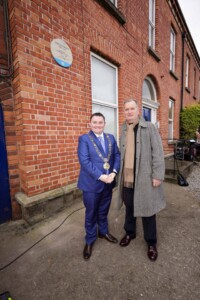

Professor Frank Shovlin (pictured above with the Lord Mayor), who wrote the McGahern biography A Writing Life, spoke at the unveiling about the significance of 57 Howth Road and gave a short reading.
The unveiling comes in the year of the 20th anniversary of McGahern’s death in March 2006.
It also comes more than 60 years after the publication of The Dark, the second of the two novels he wrote at the address.
Speaking at the unveiling, Barron said McGahern was “one of Ireland’s most remarkable literary voices, whose writing captured the lives, struggles and experiences of ordinary people with extraordinary insight.”

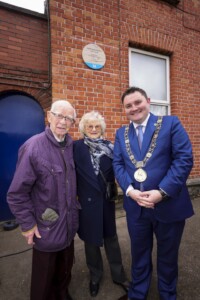
Lord Mayor of Dublin Daryl Barron pictured with Donal Cleary, who taught with John McGahern in Belgrove in 1957, and his wife Dolores. Picture credit: Chris Bellew/Fennell Photography
The Lord Mayor said the writer’s work had left a lasting mark on Irish literature and continued to inspire readers and writers across generations.
He pointed to Dublin’s place in McGahern’s life as both the city of his birth and the place where he spent an important part of his early career.
“It is fitting that Dublin, the city of his birth and an important part of his early career, honours his contribution with this commemorative plaque,” Barron said.
The plaque was erected under Dublin City Council’s Commemorative Plaques Scheme, which recognises people and events that have made significant contributions to the history and life of the city.
For readers who came to McGahern through Amongst Women or Memoir, the plaque marks a much earlier point in his career.
Both books appeared decades after the two novels he wrote on Howth Road.
It is those first two books, and the years when McGahern was still teaching in Clontarf, that give the Howth Road address its place in his story.