


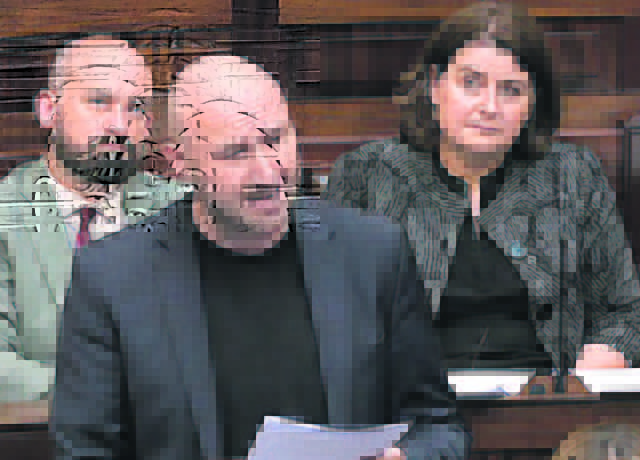
Daniel Ennis, the new TD for Dublin Central, made his first speech in the Dáil this week.
Ennis, the victor of the May 22 by-election in Dublin Central, made his first Dáil contribution on the topic of Ireland’s controversial football matches against Israel.
Opposition parties put forward motions in the Dáil last week to compel the government to force the FAI to withdraw from the matches.
The matches, scheduled for October, will both be played in a neutral venue owing to political tensions; both matches are now set to take place in Budapest, with Ireland giving up home advantage in the Nations League fixtures.
Ennis invoked his background in football during his speech, saying that “sport only works as a tool when we ensure it is grounded in respect, that is, respect for each other, the game, our teammates and our opponents.”
“We must also have respect for our athletes representing our nation and its jersey; this government has shown a complete lack of respect for our nation, supporters and athletes when it insists that we should play any sporting fixture against Israel,” he said.
“The Irish public could not be any clearer in this regard; we should not be playing against a genocidal regime,” Ennis stated.
The new Social Democrats TD dismissed the notion that football and politics don’t mix.
“People have said that politics should not be involved in this decision and that sport and politics simply do not belong together- choosing to play any fixture against the Israeli state, however, is a political decision,” he asserted.
“It is a political decision because, for Israel, this is not about football; it is about keeping its reputation clean by continuing on like nothing is happening.”
Ennis noted that when Yugoslavia were drawn against Ireland in Euro 2000 qualification, the Fianna Fáil government of the day refused to grant visas for Yugoslavian players as the war in Kosovo was ongoing at the time.
He implied that Fianna Fáil set a similar precedent by intervening in a football and political matter.
The match, then scheduled for June 1999, was eventually played in September 1999 at Lansdowne Road.
“In 1999, when our government decided that we could not justly play against Yugoslavia, it was brave. It stood up for what was right. It showed leadership and accountability. It showed the same traits that our athletes show every single time they step out to represent our country,” he said.
The government parties, however, rejected the opposition motion to put pressure on the FAI to get the matches called off.
Junior minister Timmy Dooley said, “public opinion and our opinion is involved in everything, but we have no role in making those decisions.”
“If we were to suggest that we had a role, it would be considered by others as overreach. We must be careful what we are advocating for.”
The Fianna Fáil TD said, “not responding to that request (the opposition motion) in no way limits the empathy of those on this side of the house or reduces the disgust and distress that we too feel about the atrocities that have been perpetrated on innocent civilians in that zone.”
“The FAI has stated that it intends to fulfil both fixtures against Israel in accordance with its obligations as a member of UEFA. The government acknowledges the FAI’s independence and autonomy in arriving at this decision and any decisions it may make,” he said.