


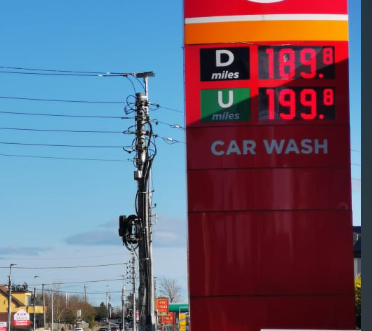
The war in the Middle East has come home to roost in Dublin, according to local elected representatives.
Despite Dublin being 6,000km from Tehran, the aftereffects of the American/Israeli bombing of Iran have started to have an impact on Dublin households, with the cost of home heating oil skyrocketing over the course of a week.
On February 27, the day before the war in the Middle East started, the average cost of 500 litres of home heating oil stood at €495.09 across Ireland.
At time of going to press on Friday afternoon, the same price stood at €855.48, and peaked at €891.48 in the time before this article appeared online on March 11th.
Sinn Féin TD Mary Lou McDonald criticised the government for taking a hands-off approach to the escalating crisis.
The Dublin Central TD said that a “brazen rip-off is happening in plain sight”, and said that merely writing a letter to the Competition and Consumer Protection Commission is a “cop-out.”
Speaking in the Dáil on Wednesday (March 4), McDonald said “the Taoiseach needs to pick up the phone and tell the top brass in these companies to stop fleecing people, and the government needs to drop its plan to increase carbon tax in the coming weeks, increases that will drive up the cost of home heating oil even further.”
“Surely, the Taoiseach can now accept it is his job to step in and act with purpose to protect households from these hikes and stop this price gouging.”
McDonald said that the Taoiseach is “left with a clear choice: he can take on these price-gouging companies or he can sit back and force households to take the pain. Which choice will the Taoiseach make?”
The first week of March 2022 saw the government under pressure to lessen the impact on households in the immediate aftermath of the Russian invasion of Ukraine; with Green Party influence, a windfall tax was placed on fossil fuel producers, with at least €200 million being raised for the Irish economy that surplus was then redistributed to Irish households in the form of energy credits.
Four years later, there are no indications that the government, which is now reliant on the support of rural independents, will deploy the same measures amid the ongoing war in the Middle East.
Taoiseach Micheál Martin said that Minister for Transport and Energy Darragh O’Brien, has asked the Commission for Regulation of Utilities, CRU, to investigate the pass-through from wholesale prices to retail prices.
The Taoiseach noted, “we had elements of this in the context of the Russian invasion of Ukraine and what happened there, although there was a longer lead-in during that crisis; price increases came a bit later in the cycle.”
He explained, “the Minister has asked the CRU to carry out an independent review of that and, in particular, the pass-through from wholesale to retail prices in particular. The Minister for enterprise has also written to the CCPC. We met with its officials on Monday (March 2) and spoke about this particular issue.
The Taoiseach also noted that the government has cut the VAT rate on electricity rates from 13% to 9% on electricity and gas bills, with that rate staying in place until 2030.
McDonald replied, “I just heard from the Taoiseach an exposition of the fact he is doing nothing. That has been a real subplot of the entire cost-of-living crisis. It is a government that is hands off, stands back and just allows households to take the pain.”
“Energy companies, supermarket chains and insurance companies are ripping people off and the government does nothing to stop them. The Taoiseach talked again about another review. In the name of God, how many reviews is the government going to do?”
She remarked, “it is probably, therefore, no surprise that this price-gouging has happened. Why would these companies not jack up their prices? They know they have nothing to fear from the government. The Taoiseach says the price-gouging should not happen. Then the question is what is the government is going to do to stop it, and the Taoiseach has no credible answer.”
Minister for Public Expenditure Jack Chambers said that temporary supports would “incentivise, potentially, further behaviour within the market”.
Speaking to RTÉ, the Northside Fianna Fáil Minister claimed it would be “inappropriate to intervene when we don’t know how this will evolve in the coming weeks and months ahead.”
Minister Chambers acknowledged that households may feel “acute pressure in the coming days”, but stressed that any response to the ongoing war in the Middle East needs to be “measured.”
Northside TD Cian O’Callaghan said that a targeted €400 energy credit to help people who are struggling with soaring energy prices.
The Social Democrats TD said, “how are elderly people on pensions, or families with young children, supposed to pay these extortionate costs? They don’t have a spare €250 sitting in their bank accounts to pay for home heating oil.”
He said that people are already “living week to week, struggling to keep their heads above water. Now, all they see on the horizon is an avalanche of price rises coming towards them.”
The Dublin Bay North TD said that electricity prices in Ireland are already the highest in Europe, with new research showing that nearly 320,000 households are in arrears on their electricity bills, and now the cost of home heating oil is rising exponentially.
“This is a crisis, and the government must intervene,” he stated.
Dublin’s MEPs have said that now is the time for Europe to show its mettle and provide a continental response to the crisis.
Fine Gael MEP Regina Doherty said “the current volatility highlights a long-standing problem in Ireland’s energy market. Irish retail electricity prices remained among the highest in Europe even during sustained periods when wholesale gas and electricity costs were falling.”
“Consumers deserve to know why prices can rise so quickly,” the Fine Gael MEP for Dublin said.
Doherty noted that Dubliners are already paying “extremely high electricity bills,” even during a period when wholesale energy costs were falling, but those reductions were not being passed on to the consumer.
She noted that the government has spent €1 billion in taxpayer funded supports over the last two years, with the intent of helping households cope with high energy costs; she said that geopolitical tensions causing another spike raises questions about how effective the retail electricity market really is.
“A temporary spike in global fuel prices due to geopolitical instability is one thing. But a persistent gap between wholesale costs and retail electricity prices is another. Consumers need to know that they are not paying more than they should,” she said.
Doherty stated, “with global energy markets becoming volatile again, restoring public confidence in how electricity prices are set is critical; consumers must have confidence that the system is working in their favour.”
Labour MEP Aodhán Ó Ríordáin was more forthright in his assessment of the situation, remarking, “Donald Trump and Benjamin Netanyahu have set a match to the international order that underscores our stability and economic security – and Ireland is more exposed to these sorts of shocks than most.”
“European citizens are now exposed to yet another cost-of-living crisis our continent; we cannot wait until families are pushed to the brink,” he said.
The Labour MEP noted that the European Union created a support system named Support to mitigate Unemployment Risks in an Emergency (known as SURE) during the pandemic to protect jobs and incomes in the wake of an economic shock; he said a similar measure was needed now.
“The European Union cannot stand on the sidelines. We must respond with solidarity, with coordination, and with a clear political message: Europe will protect its people,” he said.