
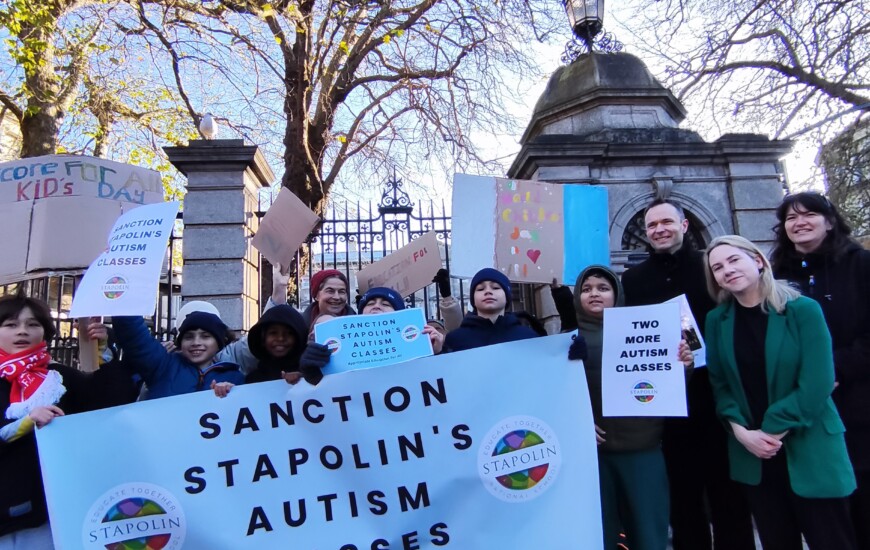
Staff at Stapolin Educate National School in Baldoyle have voiced their disappointment over a proposed “solution” to their campaign for additional autism classes.
Last week, and to great fanfare, the Department of Education announced that classes around Ireland would receive additional autism classes.
As reported in the January 21 edition of Northside People, the Dublin 13 school were left out of the announcement, despite other schools in Dublin Bay North (Manor House Secondary School in Raheny, Grace Park Educate Together National School, St Mary’s Secondary School in Baldoyle, and St Brigid’s Girls National School in Killester) receiving additional classes.
To the staff at Stapolin ETNS, being left out is a source of frustration.
Stapolin ETNS launched a public campaign last year calling for two additional autism classes to meet the needs of the children in their school and local community; the school currently have two autism classes but have identified the need for two additional classes.
At present, the school has eight children in mainstream classes who have been deemed eligible to enrol in autism classes, along with a further 30 children in the area on a waiting list.
The numbers, per the staff, justifies the school being granted extra classes, which makes the school’s exclusion from the recent expansion of classes that more stinging.
Principal Clodagh Farrell said that the school has been advised that the two requested special classes can be sanctioned “in principle”, but do not have the necessary classrooms.
“Essentially, we can have the staff, but we would have to make do with whatever bit of space we can convert around the school,” Farrell explained.
“No school would ever be told to open two mainstream classes and just figure out the space. No principal would be expected to place mainstream children in a toilet, a corridor, or a former cleaning cupboard, yet this is precisely what is being normalised when it comes to autistic children.”
“The environmental surroundings matter for all children, but it matters especially for autistic children; these are pupils who need predictable, calm, sensory-considered spaces to regulate, appropriate facilities to learn, and to feel safe. Overcrowded, noisy, makeshift spaces do not just make learning harder; they actively increase distress and dysregulation. This approach is not inclusion,” she said.
Farrell said that the current situation is “unsustainable” and that “most schools are already at capacity.”
“Free space does not exist in the way policymakers seem to imagine it does,” she remarked.
Farrell said that schools are being pushed into a mode of “constant reshuffling, temporary fixes, and crisis management, all while trying to meet the complex needs of their pupils.”
“We have no space in Stapolin. We don’t have any unused classrooms. We’ve already converted what little free space we once had into SET rooms and regulation areas. The Department is fully aware that modular accommodation is required if these additional autism classes are to open. Without modular classrooms, it is simply not possible to provide these children with an appropriate school place.”
Farrell called on the Minister and the Department of Education to urgently sanction the modular classrooms required “so that we can ensure these children have their right to an appropriate education met.”
Staff in Stapolin ETNS believe that approving classes without providing appropriate accommodation creates a dangerous illusion of progress while leaving schools to absorb the consequences.
Samantha O’Flanagan, a special needs assistant, said, “we’re repeatedly told that there is a commitment to inclusion, to equality, to meeting needs, but that’s not the reality.”
“Equality doesn’t mean ‘whatever space is left over.’ It means equal standards. It means that an autistic child’s right to education is valued to the same degree as any other child’s. We can’t open these classes without modulars. The government might be happy to give up on these children, but we won’t.”
Cliodhna Purseil, a teacher in one of the current autism classes, said, “children who require a special class deserve a classroom. If we were asked to open a mainstream class in a toilet or storeroom, there would be uproar. We will not allow the children in special classes be treated with such disrespect.”
Local TDs have been attempting to get the government’s attention on the issue.
As reported in last week’s Northside People, local TDs Cian O’Callaghan and Barry Heneghan criticised the Department for leaving Stapolin out of the list, and said that the situation at the school is a microcosm of the current state of crisis within the Irish education system.
O’Callaghan said, “the refusal by the government to sanction additional classrooms for two additional autism classes in Stapolin Educate Together is hugely disappointing. Approving additional classes but saying these should be crammed into space that the school does not have will not work.”
The Social Democrats TD said that the Department’s attitude on the issue “shows a complete lack of understanding about the importance of providing well-designed classrooms and spaces for school children and children with additional needs; this is a real step backwards and is a very regressive decision.”
Heneghan said, “if classrooms are sanctioned for Stapolin ETNS, then the necessary funding must also be provided for their construction or for modular accommodation- that’s just common sense.”
“From speaking to the school, staff are already under pressure for space, and they simply do not have suitable internal rooms to repurpose as every room is vital for their students.”
The independent TD said, “without proper accommodation funding, these classes cannot open, regardless of the approval in principle. We are therefore urging the Minister and the Department of Education to urgently review this position and ensure that the required funding is made available so that these vital places can be delivered without delay.”
Sinn Féin TD Denise Mitchell said, “if the Department is serious about every child having an appropriate school place, then they must ensure our schools have the funding they need to make that a reality.”
Mitchell praised the school for having “significant experience in providing top-quality autism classes,” and said they should be allocated more resources.
“We have a school that already has significant experience in providing top-quality autism classes. There is an enormous demand in the local community, and Stapolin ETNS is ready and willing to open a further two classes. The additional physical classrooms on site must be a priority for funding so that students have calm and appropriate classrooms in which to learn,” she said.