


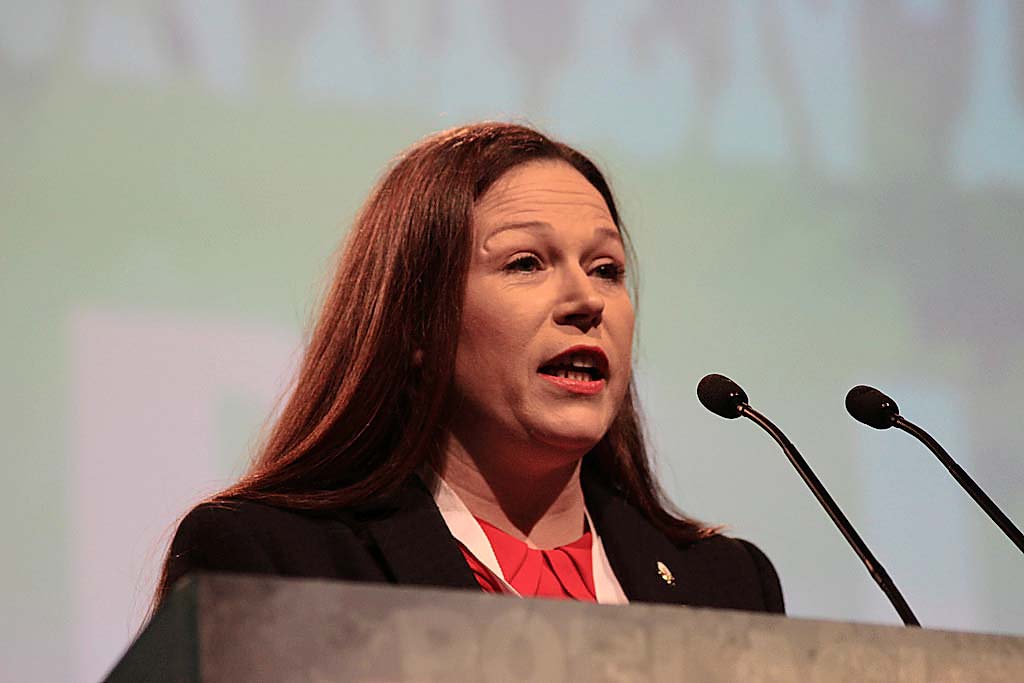
Local Sinn Féin TD Louise O’Reilly has said the government are back to embracing the austerity mindset, and families are paying the price.
The Dublin Fingal West TD criticised the government for cutting cost-of-living supports, which were present in the 2022, 2023 and 2024 budgets, but were not present in the 2025 Budget.
Supports, such as energy credits, were removed from this year’s Budget, yet a VAT cut was granted to Ireland’s hospitality industry.
The VAT cut for hospitality, which cuts rates from 13.5% to 9%, comes at a cost of €913 million to the Exchequer.
The optics of such a tax cut for large businesses while households go without government supports have irked O’Reilly.
With January serving as the longest period between pay slips for workers, O’Reilly captured the mood by noting “January is a hard month for money at the best of times, but working families all over this country are freezing and worried about getting another energy bill that looks like the last.”
She said that the government refusing to rein in energy providers and letting the market dictate prices is only serving to make an already dire state of affairs even worse.
The Sinn Féin social protection spokesperson noted, “St. Vincent de Paul has shown us that while wealthy households turn the heat up and can afford the upfront costs associated with retrofitting and renewable energy, low and middle income households are terrified to turn on the heating.”
Research by MEP Lynn Boylan found that over 300,000 households were in arrears with energy bills, with that number likely to rise as the winter drags on and the cost-of-living crisis trundles into its 5th year.
Social Justice Ireland dubbed the 2026 Budget a “recipe for austerity”, a sentiment which O’Reilly agrees with.
“When this government brought in Budget 2026, described by SJI as ‘a recipe for austerity’ it was made clear to them, day in, day out, that at the very least, they needed to increase the fuel allowance so that it would keep up with inflation; they refused to do this,” O’Reilly noted.
“In fact, the increase in the fuel allowance was half what was needed to maintain its real 2020 value. This is all the while they have withdrawn energy credits and cost-of-living supports.”
A recent report from Barnardos has found that one in five parents skipped meals or reduced portion sizes in order to ensure their child has enough to eat, in a country which, just this week, reported a Budget surplus of 3.7%.
The Sinn Féin TD said, “this government cannot keep pretending that they are not aware of the proportion of children and families that are forced into material deprivation due to their neglect of this issue. Hundreds of thousands of Irish children will remember cold, damp childhoods for the rest of their lives.”
She warned that forcing people into these conditions has “significant, lifelong mental and physical health impacts, particularly for older people, people with disabilities and people with serious illnesses.”
“We know the Exchequer is seeing significant tax surpluses again this year, Sinn Féin asks yet again, what is the point of this economic growth if the working and middle classes aren’t seeing the benefit of it?”
“What is the point of generating wealth for the few without redistributing it at a time when cost-of-living supports and energy credits are so desperately needed?.
“Sinn Féin is calling for more money to be committed to energy credits, an increase in the fuel allowance, and a cost-of-living support package to be made available urgently.
Prior to the Dáil’s Christmas break, O’Reilly said the system of “Buy Now, Pay Later” for child psychological assessments is a microcosm of where Ireland is right now as a country.
A December article by the Irish edition of The Times found that patients were offered the service when seeking autism and ADHD tests as part of the much-maligned assessment of needs system.
O’Reilly said the fact that such a system exists in a nation that is purportedly among the wealthiest in Europe is “a fairly damning indictment.”
She said the system of “Buy Now, Pay Later” should have no place in the healthcare system, saying “it is debt built up by people who cannot afford to pay out of their own pocket for a service that the state is legally mandated to provide for their kids; they are getting themselves into debt for a service that they have a lawful entitlement to.”
The Dublin Fingal West TD said that 1,841 assessment of need applications are overdue in her constituency.
When told by Minister of State Emer Higgins that the same figure was down from 1,893 compared to the same time in 2024, O’Reilly remarked, “going from 1,893 to 1,841 is nothing to be proud of really; she should probably be a bit mortified.”
“That figure of 1,841 children in my area represents families that are just left waiting. They feel very much abandoned.”
Minister Higgins, who became a Minister of State at the Department of Children, Disability and Equality in the recent mini-reshuffle triggered by Paschal Donohoe’s resignation, said that she would like to introduce a cost of disability payment in the Budget for 2027.
The Dublin TD told the Irish Examiner that plans are being drawn up in the first quarter of 2026 to introduce a cost of disability payment, in addition to existing social welfare benefits, with plans for it to be in place for October’s Budget.
Social care has become a millstone around the Fianna Fáil and Fine Gael government’s neck since they took office in 2020; in early 2025, this publication covered a number of protests outside the Dáil and Department of Education and heard from parents who said their children with additional needs are being failed by the state.
When the Dáil returns next week, the Social Democrats will bring forward a motion, calling for an emergency €400 winter payment for people with disabilities.
Party spokesperson on disabilities, Aidan Farrelly, said, “it is deeply frustrating to hear Minister Higgins speak in vague terms of her ‘hopes’ to see a cost of disability payment included in the next budget; the reality is that disabled people are struggling right now.”
“Talking about future plans does not put food on the table, pay energy bills, or cover the cost of transport, equipment, or personal assistance,” he said.
The Kildare TD said “the government had an opportunity in the most recent Budget to act immediately by introducing a cost of disability payment. Not only did it not do so, it also stripped away other supports, resulting in disabled people being an average of €1,400 worse off this year.”
While the opposition parties have appeared split on major social issues such as immigration, trans rights, fox hunting and how to tackle climate change, they have shown a consistent, united front on the issue of disability, one of the government’s historic weak spots.
February will mark 10 years since the 2016 general election, where the anti-austerity movement materialised and made themselves known at the polls.
TDs like O’Reilly were among those elected to the Dáil as Sinn Féin found its voice as a party that was against austerity measures, sweeping Labour from government in the process.
A decade later, austerity is in the rear-view mirror as far as the day-to-day milieu of Irish politics is concerned, but the scars still linger.