


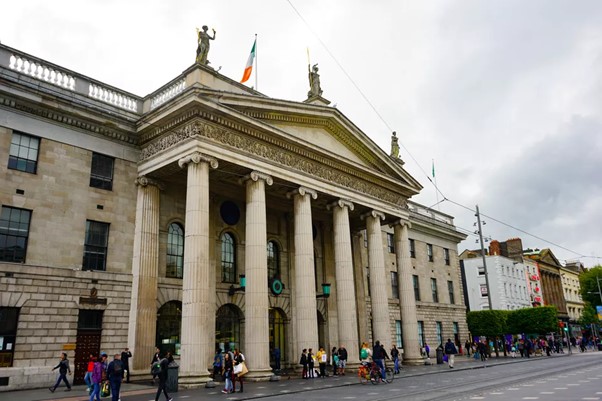
The revamp of the GPO has received major government backing.
The National Development Plan has earmarked between €200 and €500 million in funding for a major upgrade of the O’Connell Street site.
The Office Of Public Works will be in charge of the upgrade works, with a document from the Department reading calling for a “repair and expansion of facilities in the GPO to meet a range of activities, including cultural, museum, office, civic, and retail requirements.”
Procurement is underway for the project, with a construction deadline of 2029 to 2032 cited.
A revamp of the GPO was part of the Dublin City Taskforce, commissioned by Simon Harris shortly after he became Taoiseach in April 2024, and is seen as part of a none-too-subtle attempt to reclaim the tenets of Irish republicanism from Sinn Féin.
Earlier this year, Fianna Fáil TD and Minister for Justice Jim O’Callaghan stated that Sinn Féin does not “have a monopoly on Irish republicanism.”
The Taskforce recommended a revamp of the GPO in a bid to tackle city centre dereliction and improve the image of O’Connell Street.
Fine Gael TD James Geoghegan, the party’s Dublin spokesperson and former Lord Mayor of Dublin, said that Dublin should be following the example of Paris, Rome and London, and have a breathing, historical building in the city centre.
“Look around the world where tourists and people flock to, the White House in Washington, the Tower of London, Paris’s Eiffel Tower, the Colosseum in Rome – historical buildings which have a unique connection to their cities and countries,” the Dublin Bay South TD noted.
Geoghegan noted that a redevelopment of the GPO should be a “celebration of the republican ideals envisioned in 1916.”
“The GPO is our most important national building, and it is smack bang in the middle of our capital city. Its redevelopment should be co-designed by the public with a process that brings people together,” he said.
The Fine Gael TD said there is precedent for bringing people together via a public works project; in the aftermath of the 2008 economic crash, the government published a national ideas campaign which asked members of the public for ideas of how to stimulate the economy after the crash.
Now, Geoghegan says that members of the public should be allowed to have their say and weigh in about how to improve Dublin.
The former Lord Mayor pointed to the success of the Guinness Storehouse, which has welcomed 25 million visitors in 25 years, and said the success of the Storehouse should be the template for the revitalisation of O’Connell Street.
“A similarly ambitious museum, co-created with the public at the birthplace of our Republic, will revitalise the city,” he predicted.
“At 25,000 square metres, two-thirds larger than the pitch in Croke Park, the GPO should the national centrepiece that greets visitors with the story of our Republic. Everyone should have a say in how it is reimagined.”
“A reformed GPO can prove to be the foundation stone for a new future for our city centre,” he said.
Elsewhere in the National Development Plan, a big-budget revamp of Áras Mhic Dhiarmada has also been earmarked.
€100 to €200 million of funding has been allocated for what the document calls “upgrades, repair, and replacement of end-of-life building services/ life safety systems for an existing 20th-century protected structure.”
As the Busáras building is used as the Department of Social Protection’s HQ, the document also calls for the building to be upgraded so it can “accommodate civil servants.”
The government’s plans to revamp Dublin City Centre come in the wake of Minister for Transport Darragh O’Brien’s major transport spending plan being greeted with a mixed reaction.
While O’Brien was championing the €24.3 billion in expenditure for transport infrastructure (including the construction of the Spencer Dock DART station and more funding secured for Metrolink), the plan has drawn severe criticism since.
As part of the plan, spending was not allocated for the DART+ South-West project despite being designated as a “shovel ready” project, and the extension of the Luas Green Line to Finglas was put “on the long finger” per Social Democrats TD Cian O’Callaghan.
The week in Irish politics has been dominated by Fianna Fáil Minister Jack Chambers attempting to tackle Ireland’s reputation as a nation where very little is built and pledged to speed up Ireland’s Kafka-esque planning legislation.
O’Callaghan questioned the government’s sincerity in delivering major infrastructure, with a distinct sense of unease among Dublin commuters in recent weeks.
Employers mandating a return to office for employees has resulted in Dublin’s already outdated traffic infrastructure being unable to cope with the return to office, with little to no work done on upgrading Dublin’s ageing public transport infrastructure in the five years since the Covid-19 pandemic.
O’Callaghan spoke to the public frustration, saying “people are sitting in traffic congestion, or standing on cold mornings watching packed buses pass them by, and want to see the government act urgently to get key infrastructure built,” the Dublin Bay North TD said.
“Instead, the government’s decision to delay much-needed public transport infrastructure shows a complete lack of urgency. This impacts on people’s mental health and wellbeing, is damaging to our environment and also increases costs for businesses.”
Pointing to the Draghi Report on European Union, O’Callaghan noted that Ireland has the slowest regulatory and planning processes in the EU, a stat which the Soc Dems TD called “a damning indictment of the government’s record of drift, delay, and deflection.”
A day after O’Callaghan criticised the government’s “delay and deflection” approach, the National Development Plan was announced.
“If the government are serious about delivering critical infrastructure, they must reverse their decision to postpone much-needed public transport projects,” he said.
Prior to her October election as President, Catherine Connolly said that GPO and Moore Street “must be revitalised.”
In October, Connolly said “the idea of developing this area as a 1916 Cultural Quarter would be transformative for Dublin’s North Inner City, for cultural tourism, and for the people who live there; it could become a vibrant centre of history, education, arts and community life, breathing new life into a part of Dublin that has been neglected for far too long.”
“For years we’ve seen promises, plans, and reports – but no meaningful action. The site remains derelict while developers’ circle. This Government has shown itself powerless in the face of corporate greed and cultural vandalism.”
She said that should she become President, she would “use my voice to promote the protection of Ireland’s heritage and the revitalisation of Dublin’s historic heart”.
“Our national story must be visible and valued. The GPO and Moore Street must be restored, renewed, and reclaimed for the people. The government’s inaction is unacceptable – the time for excuses is over.”
With a Galwegian President in the Áras wanting to see the North Inner City revitalised, and a growing sense of frustration among commuters from the city and beyond the Pale, the pressure is now firmly on the government to walk the tightrope of delivery.