


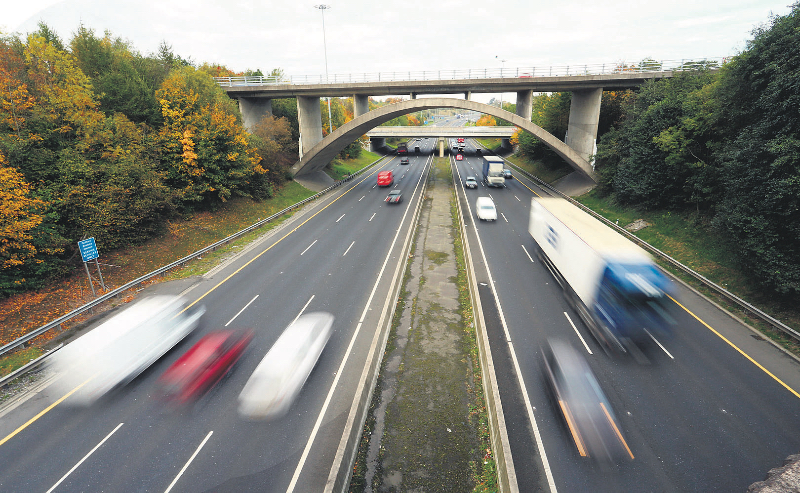
LAST week’s revelations that the M50 is becoming a virtual car park will come as no surprise to weary commuters.
Even the slightest incident on Dublin’s main motorway seems to have a devastating knock-on effect on traffic throughout the city, resulting in painfully slow journeys, lost productivity and less family time.
Barely a day goes by when you don’t see some sort of ominous warning about ‘queues’ on the electronic traffic signs. The capital’s rush hour is now a whopping eight hours as workers seek to leave home or work earlier to avoid the anticipated chaos.
The fact there are tolling charges on this route merely adds insult to injury. The social and economic costs to Irish society are enormous and the Government is under renewed pressure to come up with solutions to Dublin’s congestion crisis.
Social Democrats TD Catherine Murphy repeated her calls for a “strategic game changer” to deal with tailbacks across Dublin and the wider commuter belt.
She said: “The economic costs, including fuel costs, childcare costs, the cost of doing business, insurance costs and, ultimately, climate costs are enormous. But the social and personal costs are also considerable with families and individuals being forced to leave the home earlier, get home later and spend considerable amounts of time sitting in traffic.
“We either invest now or we pay later – it’s a no-brainer really.”
Deputy Murphy has called for an urgent capacity audit of public transport to be carried out. She also wants Minister Shane Ross to publish his review of the DART Underground project, which had been shelved by the last Government.
“Ireland is among the very few developed nations where urban underground high capacity rail has not been attempted as a solution to congestion and Dublin is one of the very few large cities in the world without an underground system,” she added. “The absence of such a transport network means that people are forced to rely on cars, meaning our emissions targets look increasingly unachievable – a problem that will cost us financially in terms of fines.”
Dublin Chamber of Commerce also waded into the debate last week, calling on the Government to triple investment in transport infrastructure.
This would see the annual spend increase from €150m to €500m.
The recent bus strikes may have temporarily soured our appetite for public transport as a reliable means of getting to and from work. The reality is, however, that travelling by car in Dublin is becoming the least sustainable option.
Like it or not, significant investment in public transport – supported by private operators on certain routes – is the only viable solution for dealing with Dublin’s daily traffic nightmare.