


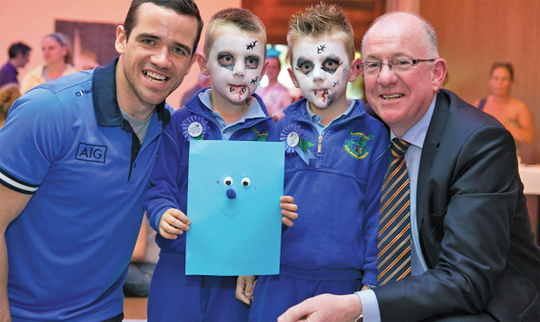
OVER 2,500 Northside children are set to benefit from a pioneering programme designed to help parents prepare their children for going to school.
Minister for Children and Youth Affairs, Charlie Flanagan, formally launched the second phase of the Preparing for Life programme at the Dublin Airport Hilton Hotel. It will cater for children in the Dublin 5 and 17 areas.
The Department of Children and Youth Affairs, together with the Atlantic Philanthropies, is funding the programme as part of the Area Based Childhood Programme. It will invest e30 million in 13 prevention and early intervention sites throughout Ireland between 2013 and 2016.
Preparing for Life is an evidence-based prevention and early intervention project that works to improve children’s lives by supporting parents, early year’s practitioners and teachers.
The programme works with families, health services, maternity hospitals, pre-schools and schools from pregnancy through childhood with the overall aim of supporting children to achieve their full potential.
Preparing for Life began as an early intervention research project in 2008.
Speaking at the launch, Noel Kelly, manager of Northside Partnership’s Preparing for Life Programme, said:
“Since 2008, Preparing for Life has worked with 200 families in Dublin 5 and 17, supporting parents to get their children ready to start school.
“Since we began our work, we have seen improvements in teachers’ assessment of the school readiness of children entering Junior Infants in our target area.
In 2008, teachers judged just 49 per cent of children to be school ready. In 2014, that figure increased to 63 per cent.
“Research with parents taking part in our home visiting programme in Phase 1 has shown that the changes we are helping parents to make have led to improvements in child health, child development, parenting and the home environment.
?
Mr Kelly said that the most recent report, published when all children had reached the age of 24 months, indicated significant differences on 21 per cent of the outcome measures.
“Of particular interest were findings that children from families who took part in the home visiting programme were less likely to suffer from asthma and socio-emotional problems, while the parents themselves were less at risk of clinically significant parenting stress,
? he added.
“The new phase of Preparing for Life will allow us to expand our prevention and early intervention work with children and families in our catchment area.
“In this new phase from 2014 to 2016, we are building on our work to date and are working in partnership with families, health services, maternity hospitals, early years settings and schools to deliver a range of evidence based interventions.
?
Minister Flanagan acknowledged the important work done by Northside Partnership in recent years in the development of early intervention programmes and informing the design of the ABC programme.
“A new approach to breaking the cycle of child poverty through an area-based approach based on international best practice is a key commitment of the Programme for Government and significant progress has been made in delivering on this commitment,
? he said.
“As a Government, we are committed to addressing child poverty through innovative approaches and partnership.
?
John Carr, a former General Secretary of the Irish National Teachers’ Organisation (INTO) and chair of the Northside Partnership’s Preparing for Life sub-committee, said:
“As somebody who has spent my life involved in primary education as a teacher, principal and trade union official, I fully appreciate the importance of children being school-ready so that they can really prosper in school.
“I also know from interacting with thousands of teachers that teachers can predict with frightening accuracy those children whose futures are already compromised as soon as they arrive in school at the age of four or five.
?
Mr Carr added:
“If it is that obvious at so young an age, we owe it to our children to change our approach by intervening earlier so that we minimise the number of children that arrive in school not ready to achieve their full potential.
?