
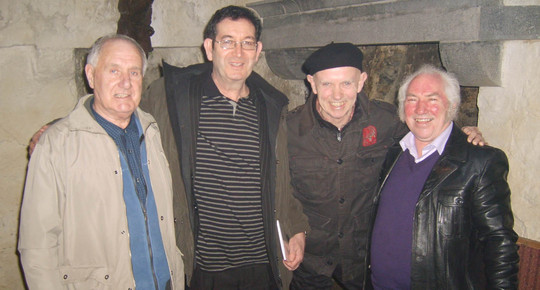
A SOUTHSIDE author has written a new tome on the
little known history of one of Dublin’s most intact Anglo Norman castles.
Michael O’Flanagan, who is from Walkinstown, recently
launched his new book
‘A History of Drimnagh Castle’, which explores the origins
of the 13th century structure and its purpose as a defensive outpost for the
ruling elite.
It also covers the subsequent use of the castle in
later centuries by prominent figures of the British establishment.
The castle, built of local grey limestone, consists of
a restored Great Hall and medieval undercroft, a tall battlement tower with
lookout posts, and other separate buildings including stables, a dairy and
folly tower.
Michael wrote the book because until now there has
been little information available about the castle’s history.
Michael, who publishes the poetry magazine
‘Riposte’,
has also written a book about Irish patriot, Henry Joy McCracken, who was a
founding member of the Society of United Irishmen in the late 18th century.
He explained that the castle was built in 1212 and was
given by King John of England to the Barnwall family.
Drimnagh Castle was the western outpost of the Norman
settlement in Dublin going back to the 13th century. Irish clans of the
O’Byrnes and the O’Tooles constantly harassed the Norman settlers and Drimnagh
Castle was an important bulwark and warning post against these attacks.
“For nearly 300 years the O’Tooles and the O’Byrnes
were up in the Dublin Mountains and they used to come down and rob cattle,
?
Michael explained.
“You have to remember that at this time Drimnagh was a
big forest with thousands of trees and a lot of land with very few buildings.
Drimnagh Castle was an outpost in the west of Dublin effectively and there was
no record of it ever being captured.
?
Michael said that later, in the 17th century, other
prominent members of the British establishment lived in the castle.
“One of the most important things about the castle is
that Lord Lansdowne William Petty, who was one of the owners of the castle,
stayed there from time to time. He was a Member of Parliament in Britain.
“Another person who lived there was the British
Viceroy to Ireland, Sir Adam Loftus. He is recorded as having cut down 7,000
trees in Drimnagh.
?
Michael further revealed that the castle was almost
continuously inhabited from 1212 until 1953 when it was last lived in by a
family called the Hatch’s.
In 1986 artist Peter Pearson, who was a prominent
member of An Taisce, initiated the restoration of the castle that was later
reopened in 1996 when the works were completed.
The castle is currently open to the public and is
available for hire for weddings.
The History of Drimnagh Castle is available for the
price of e5 at the visitors’ centre.