


By: Darren J. Prior
The first week of November is an important week in the voluntary assisted dying movement’s calendar.
On November 2 every year since 2008, World Right to Die Day has been marked in many countries, and there are sometimes other events held that week as part of the commemorations in different countries.
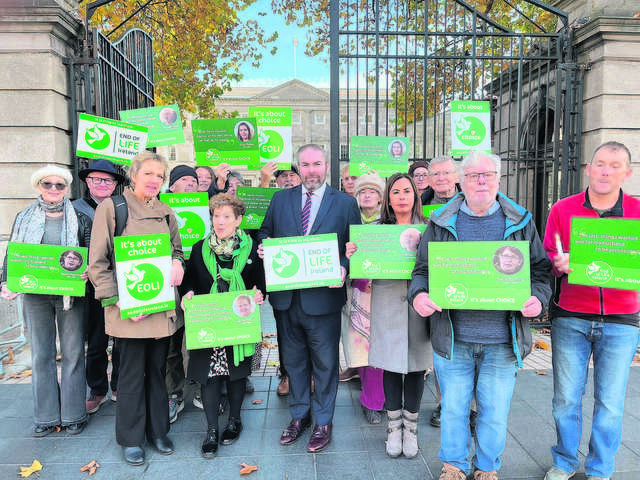
The day in Dublin and Ireland this year was marked by a demonstration outside the Dáil organised by End of Life Ireland, followed by a gathering in the Dublin Unitarian Church. Two days later, there was an EU event organised by the S&D Group in Brussels on the issue of voluntary assisted dying, called “My Last Right”, where a petition at EU level was discussed.
Janie Lazar, chair of End of Life Ireland, was again the main organiser of the two events in Dublin on World Right to Die Day, and she was also a panellist at the event in Brussels.
Speaking to Dublin People, Janie said that marking World Right to Die Day every year is “extremely special because what it does is it honours the courage of all advocates who have campaigned for assisted dying, who in many cases have died before legislation was passed. I think it is important to recognise the courage as well for anybody who is living with a terminal and incurable illness. But for people who have campaigned tirelessly around their death, I think it is important to mark their courage.”
Politicians attending the demonstration outside the Dáil included Labour leader Ivana Bacik, Barry Ward TD, Jen Cummins TD and Cllr Gino Kenny. The Dáil and Seanad do not sit on Mondays, so there may have been a larger number of national politicians present if the demonstration had been held on a different day.
No Irish MEPs “sadly” attended the S&D Group event in Brussels, according to Janie.
Asked about the likelihood of voluntary assisted dying being introduced at EU level, Janie explained that the question is not a simple yes-or-no situation.
“I think it is a longer-term initiative. With any EU petition, any major issue that has an impact on each country’s constitution – the legislation for something like assisted dying would be handled according to the constitution of each country.
“But I think it is important for the right, if you like, to assisted dying to be recognised. While it may possibly be established as an international human right, how it would operate in individual countries is down to each country, which develops its own legislation, and it is important for that to be recognised.”
Speaking about politicians in Ireland and Irish MEPs, Janie went further:
“Our politicians need to recognise that people are still travelling from Ireland to have an assisted death elsewhere, and everyone’s wish is to die at home in Ireland. Nobody should be forced to travel abroad like a criminal and not be able to die at home here at a time of their choosing.
“Is it unlikely that it will be picked up by our politicians? Well, I would ask the question – is it only when something directly impacts a politician that that issue becomes acutely relevant to them? Because this shouldn’t be a party issue. This is a very human issue, and at the moment, the way the issue is being disregarded by, if you like, our leading two parties, Fine Gael and Fianna Fáil, I think it is inhumane and cruel,” Janie added.