Dateline: Saturday, September 12, and Donald Trump is paying a visit to Phoenix Park.
The controversial American president is in town for a visit and is meeting with Ireland’s various government leaders.
During his meeting with Taoiseach Micheál Martin, Trump will make a typical off-the-cuff remark that he was in favour of a United Ireland, stating “it would be natural to put north and south together.”
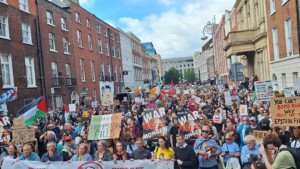
While the media class lost the run of themselves over the comments, overshadowing the visit, thousands lined the streets of Dublin to protest Trump’s visit to Dublin.
Elsewhere on the Northside, thousands of protesters turned out to voice their opposition to the Commander-In-Chief.
When Barack Obama visited Dublin in 2011 during his first term, there was breathless coverage of Obama enjoying a pint of Guinness in his ancestral home in County Offaly and receiving a rockstar welcome at College Green.
Trump’s relationship with the Irish people is, being diplomatic, a lot more strained.
To the people who took time out of their Saturday afternoon to protest his visit, he is the man solely responsible for higher energy bills for Irish households this winter.
Politicians and supporters from all of Ireland’s opposition parties were at the protest, ranging from the Greens, Soc Dem, Labour, People Before Profit, Sinn Féin and various independents.
Some TDs, Senators, councillors and MEPs were just there as concerned citizens first, and politicians second; others were leading the protest and taking part in chants.
Starting from the very top of O’Connell Street, the protest march made its way down the capital’s main thoroughfare; unlike the protests which shut down the city centre for five tense days in April, the protest was relatively peaceful.
In our coverage of the fuel protests, there was clear anger at the government over its failure to address the fuel crisis, brought about by Trump and Benjamin Netanyahu’s folly of a war against Iran.
The same people who shut down O’Connell Street for five days in April over high fuel prices were conspicuously absent from the protest against the man who is most at fault for the high fuel prices.
Indeed, no Trump supporter dared to show their face at the protest; whether that is an indictment of how unpopular he is in Ireland, or whether the support for him is entirely manufactured online, that is a debate for our readers to decide.
On the streets of Dublin there was no Elon Musk-designed algorithm to tell Trump and his supporters how great he was; the mood at the protest wasn’t necessarily charged, but the baseline was “pissed off.”
As a result of this protest, there was no €505 million bailout from the Exchequer, but there was a strong takeaway message: the opposition was not happy about the red carpet being rolled out for Trump.
An opposition that appeared united when backing Catherine Connolly for the Áras this time last year has struggled for cohesion and unity on big-ticket items since then.
On Saturday afternoon, they were all united by a burning hatred of Trump and his conservative agenda, along with dissatisfaction at a government that welcomed him to Irish shores.
Solidarity TD Ruth Coppinger was biting in her remarks to the crowd, as it gathered on Molesworth Street.
The Dublin West TD noted that Tánaiste and Fine Gael leader Simon Harris was very quick to criticise comments made by Michael O’Leary about rape, but was quick to “cosy up” to Trump, a man convicted of sexual abuse in 2023.
“He assaults with impunity, and that’s all okay with the Irish government and establishment,” she told the crowd.
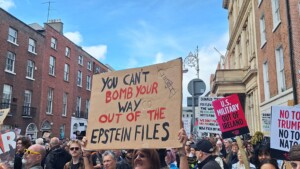

Independent Senator Alice-Mary Higgins warned the government not to succumb to Trump’s agenda of AI-driven, data-centred, fueled capitalism.
The independent Senator branded the government a “disgrace” for inviting Trump to Ireland, considering his “imperialist” adventures in Venezuela and Iran, and his violent overtures towards Cuba and Greenland in the last few months.
“We are here today to say no to your dirty LNG gas, no to your data centres, no to your AI, and no to your algorithms that enable fascism.”
Labour TD Ciáran Ahern said that Trump “stands for everything we are against,” and said it was “heartening” to see thousands of people turn out against Trump.
The Dublin-South West TD branded the government as “sycophants” and dubbed them “disgusting” for “cosying up to a fascist.”
Sinn Féin TD Donnchadh Ó Laoghaire attempted to wed the visit of Trump to the ongoing debate about the Triple Lock.
With the Dáil returning this week, the Sinn Féin TD and foreign affairs spokesperson said that Ireland was at risk of being dragged into the “circus” started by Trump, and that “the people should have a say.”
“Put it (a referendum on the Triple Lock) to the people, and I am sure you will get your answer,” he told the crowd, to cheers.
Social Democrats Senator Patricia Stephenson said that while locals in Doonbeg may be happy with all the prosperity and employment he has brought to their village, the same can’t be said for villages that have been bombed in the Middle East with Trump’s support.
“No matter how many golf courses Donald Trump builds in this country, he is not welcome here,” she said.
People Before Profit leader Richard Boyd Barrett was in full voice; the Dún Laoghaire TD was among those at the heart of the protest, leading chants of of “Donald Trump, war criminal,” and “the people’s voice is loud and clear, Donald Trump is not welcome here.”
Addressing the crowd, Boyd Barrett said, “every single household in this country is facing rocketing energy prices because of Trump’s bloody warmongering.”
“That means serious hardship for hundreds of thousands of households in this country and that is now set to get worse this winter, as Trump’s warmongering continues.”
With the opposition united in their hatred of Trump, we asked some the normal residents of Dublin what they think of the protest.
Carija, who moved from Atlanta, Georgia to Dublin in 2010, said that it was “heartening” to see her adopted homeland speak out against Trump.
“I’m so happy to see that Ireland feels the same way we do back home,” she said.
Carija said that American citizens who live in Ireland may not necessarily be aware that they are still eligible to vote, and encouraged any American people living in Ireland to register to vote ahead of the November elections.
With November’s mid-terms gearing up to be a bruising affair for Trump, meaning his domestic agenda will face major roadblocks, Trump will still have unilateral power to act as he sees fit on foreign affairs, in accordance with the American constitution.
German citizen Jakob, who moved to Ireland last year (who told us that the housing crisis in Germany is “even worse” than in Ireland), said it was “good to see Ireland make a stand like this.”
“You can see the damage he has caused in my country,” referring to the recent success of the far-right AFD and Trump’s none-too-subtle backing of them.
“I just hope nothing like that happens here.”


Noel travelled up from Kilkenny to attend the protest.
“I thought of that famous saying from World War 1, you know how the British asked ‘what did you do in the war, dad?’, I think I should be out here, voting with my feet, showing my opposition to this tyrant.”
Shauna travelled from Claremorris in County Mayo to attend the protest; despite other anti-Trump protests taking place in Doonbeg in County Clare, she felt that she had to “send the government a message” by attending the protest in Dublin.
Shauna said she was “invigorated” by politics during the Catherine Connolly campaign last year, and has become more engaged in politics as a result.
“If you look at who we elected as President last year, this woman who came from very little in Galway, through hardship, yet she still has unwavering principles; you compare her to Trump, who had everything handed to him and he still acts like a brat, the difference is night and day.”
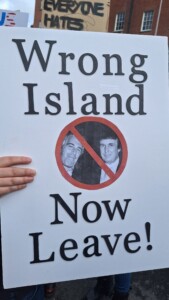
Trump’s relationship with the disgraced financier Jeffrey Epstein was an easy target for protesters, and one stand-out banner best captured the mood of the protesters.
It simply read “wrong island – now leave!”.