


By Darren J. Prior
The Africa Centre Ireland, or Africa Solidarity Centre Ireland as it is also called, which is based on Amiens Street, has welcomed the UN vote on September 4 which overwhelmingly called for the UN to adopt the Equal Earth map.

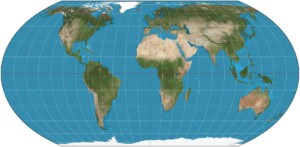
The Equal Earth Map, uploaded by Daniel R. Strebe to Wikimedia Commons
According to Lassane Ouedraogo, chairperson of the centre, the UN vote marks a significant starting point in addressing the geographical misrepresentation of Africa associated with the Mercator map since its creation in 1569.
While acknowledging that the Mercator map was created for the purpose of better maritime navigation, Lassane told Dublin People that there is also a colonial and post-colonial legacy associated with the map which remains with us today, but which is now beginning to change.
The distortion on the Mercator map matters, according to Lassane, because:
“What people see influences what they understand, imagine and value.”
The problem is that “generations of educational materials, media representations and digital visualisations have frequently presented the continent (Africa) through geographical projections that can make it appear considerably smaller than it actually is.
“The Equal Earth projection, which the UN resolution encourages governments, educational institutions and other actors to consider, provides a more accurate representation of relative landmass size.”
“What happens when generations repeatedly see their own continent represented as smaller, more peripheral or less significant than it really is?
“These questions are particularly important for Africans and people of African descent living in Ireland and across Europe.”
The vote in favour of using the Equal Earth projection map will not “by itself dismantle racism or colonial thinking”, according to Lassane, but “it can become one element of a broader effort to decolonise education, knowledge production and public consciousness.”
The vote at the UN on 4 September, initiated by Togo and supported by the African Union, is non-binding, but it is expected that the vote will usher in change within UN organisations and agencies, which will have a further ripple effect across the world.
Lassane and the Africa Centre welcomed the Irish Government’s decision to support the UN motion and noted positively for Africans, African states and the AU that:
“The overwhelming UN vote demonstrates that African diplomacy can successfully place questions of historical representation and global equity on the international agenda.”