
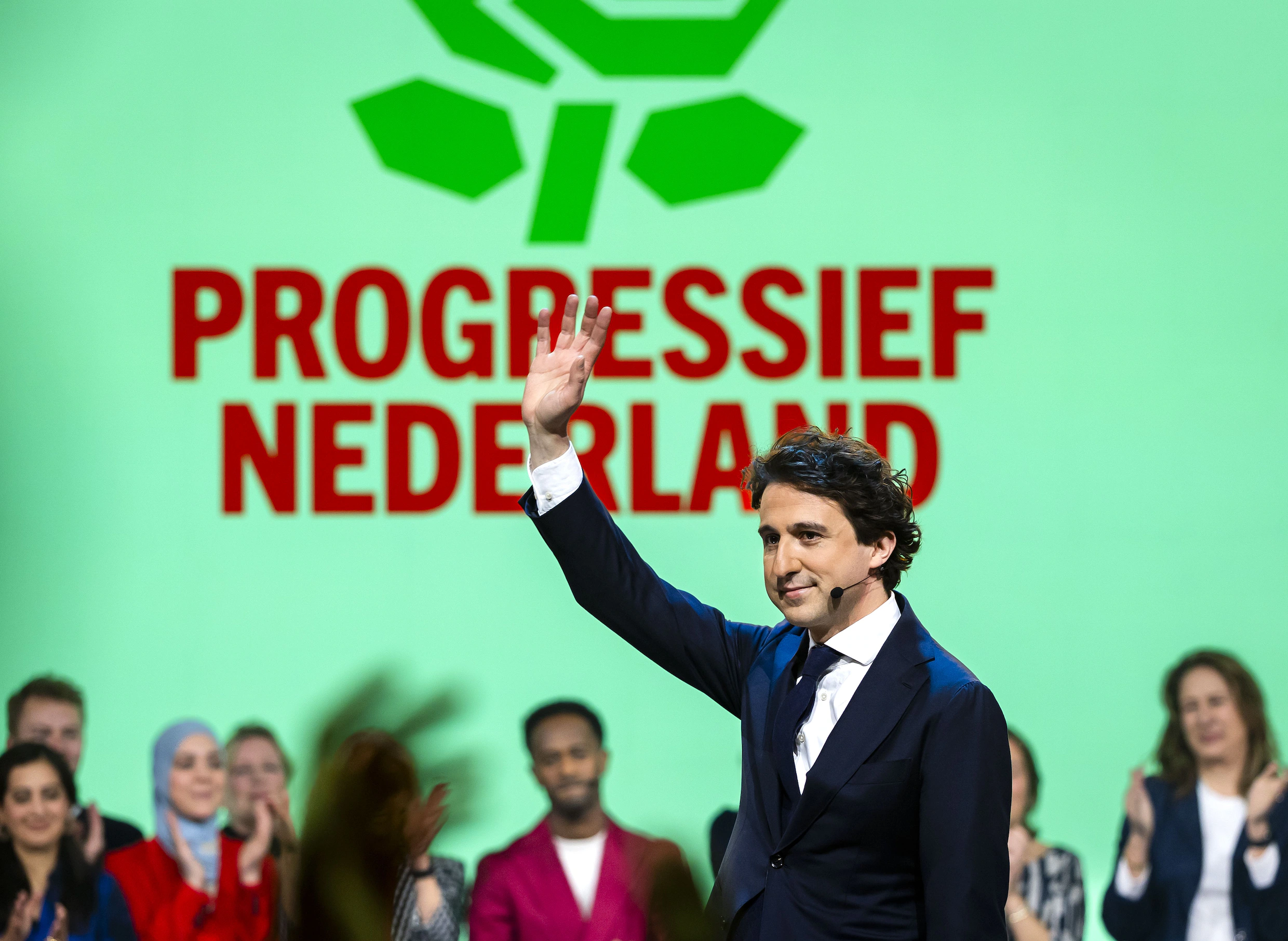
The beginning of July saw the merging of two Dutch political parties; Labour and GroenLinks.
The combination of the Dutch Labour Party and GroenLinks (Green Left), has seen two historic parties combine in an attempt to end years of centre-right rule in the Netherlands.
Dutch progressives haven’t had one of their own as Prime Minister since Wim Kok left office in August 2002 in the wake of that year’s general election.
Disastrous stints in coalition with VVD, the Dutch answer to Fine Gael, massively bruised the Labour brand, and saw Dutch progressives flee to GroenLinks, the Dutch answer to the Green Party.
The parallels between Irish Labour and their Dutch cousins are striking; both of them have enjoyed stints in government and have played a part in shaping the social and economic landscape of their respective nations.
Both parties have struggled in the post-2008 economic consensus and post-pandemic era, and the age of Trump 2.0 has left them scrambling to find their identities again.
In the case of Dutch Labour, where the 2017 general election was roughly analogous to Labour’s performance in the 2016 Irish election, it prompted a near trip to the grave and some years of soul-searching.
The result of the soul searching was a merger with GroenLinks, the party that outflanked Dutch Labour from their left on climate and social issues.
After years of internal party movements and talks, the decision was made to fight the 2023 general election under the same umbrella, a result which landed them in second place behind Geert Wilders’ far-right PVV.
The same grouping was repeated for the 2024 European elections, where the grouping won 8 of the 31 European Parliament seats Dutch voters sent to Strasbourg, but the 2025 general election saw the grouping fall to third place amid a last-minute surge for the liberal D66.
Losing ground to D66 was a setback for the alliance; D66 was responsible for many of the socially progressive policies that people have come to expect from the Netherlands, such as secularism, expanded LGBTQ+ rights, and relaxation of drug laws.
Despite the 2025 setback, over 90% of both Dutch Labour and GroenLinks members voted to merge the parties into one, now named Progressive Netherlands, and the merger came into effect on July 1.
The reader is now asking, after reading the last 350 words, what this has to do with Irish politics; the answer is, quite a lot.
This month marks five years since Ivana Bacik’s by-election, regarded by those within Labour circles as the start of a comeback for the party.
The 2024 general election, which saw the party win double-digit seats for the first time since the ill-fated coalition, came in the wake of the party winning its first European seat in 2009.
Since 2024 however, one might argue a sense of stagnation has set in.
With a ceiling of 6% in the polls, it is unlikely that Labour will repeat the highs of the Spring Tide or the Gilmore Gale, and if anything, the Social Democrats are best positioned to capture that once-in-a-generation bounce for progressives.
Labour has polled around 4% and 5% in polls over the last year, while the Social Democrats have been in the double digits, fairly consistently, for the best part of a year at this stage.
Of course, analysing a poll this far out from a general election is risky business (polls from this time in 2022 had Sinn Féin at 35% and Mary Lou McDonald as the Taoiseach in waiting),
The recent Galway West by-election has shown that the party can still have a big impact when the chips are down (it was their transfers that were the difference between Independent Ireland gaining their fifth TD and Fine Gael gaining a Dáil seat), but there is a sense that Labour are being left behind while their breakaway party is flying high.
There is also the curious case of the Greens; the Dublin Central by-election, much like Labour’s performance in Galway West, prove that It Was Woke Wot Won It and there is still an appetite for progressive politics over whatever Sinn Féin are pretending to be this week.
Now that the Greens are a one-man show in the Dáil, the Greens are in their new normal; wipeout after a term in government, rebuild, and come back after 10 years.
Roderic O’Gorman assumed control of the Greens in the summer of 2024, just after Éamon Ryan and Catherine Martin resigned in the wake of bad local and European results, and he led them into an ultimately doomed general election campaign.
With just him and Senator Malcom Noonan as the only Green members left within the Oireachtas, O’Gorman has done a decent attempt at trying to remind people all of the good things from the last government.
O’Gorman has used his Dáil time and whatever media cache he has left to explain to people that the Greens delivered expanded public transport, actually took climate change seriously, improved cycling routes, enacted the world-first Basic Income For Artists, taxed energy companies, and secured energy credits for households in their last stint in government.
The Dublin West TD hasn’t quite grasped the opportunity to rebrand the Greens into a Zack Polanski-style eco-populist party, but instead appears to be content to remind people that when the Greens go into government, they deliver.
Like Labour, however, they have also hit a ceiling in polls; the party has never gone above the 3% mark in the current polling cycle.
It became apparent in the 2024 general election that Green voters from 2020 (that is to say, social progressives who would never vote for Sinn Féin), bolted for the Social Democrats and Labour.
Which brings us back to the Progressive Netherlands party.
The Netherlands, much like Ireland, is a coalition country.
The Dutch government, which took office earlier this year, consists of D66 (socially progressive, economically liberal), VVD (the Dutch answer to Fine Gael, but have undergone a sharp right-wing turn in recent years) and CDA (what would have happened to Brendan Corish-era Labour if it survived to the modern day).
Both Labour and the Greens have shown that they will govern if the numbers are there and they believe their coalition demands can be met.
The recent decision by Labour and the Greens to carry on with their Dublin City Council coalition with Fianna Fáil and Fine Gael has raised eyebrows in certain quarters.
Labour councillors on Fingal County Council walked from a similar pact in mid-2025, and have made life difficult for the government parties on the Northside.
Ireland has a decent number of political parties that were founded after a big name split off and founded their own party (the Progressive Democrats in the 1980s, the Democratic Left in the 1990s, the Social Democrats in the 2010s), but mergers are rare in Irish politics.
An outright merger, like what we have seen with Progressive Netherlands, would be difficult to pull off, but a joint list between Labour and the Greens, like what happened in 2023 and 2025, could be a precursor for deeper co-operation between the parties.