


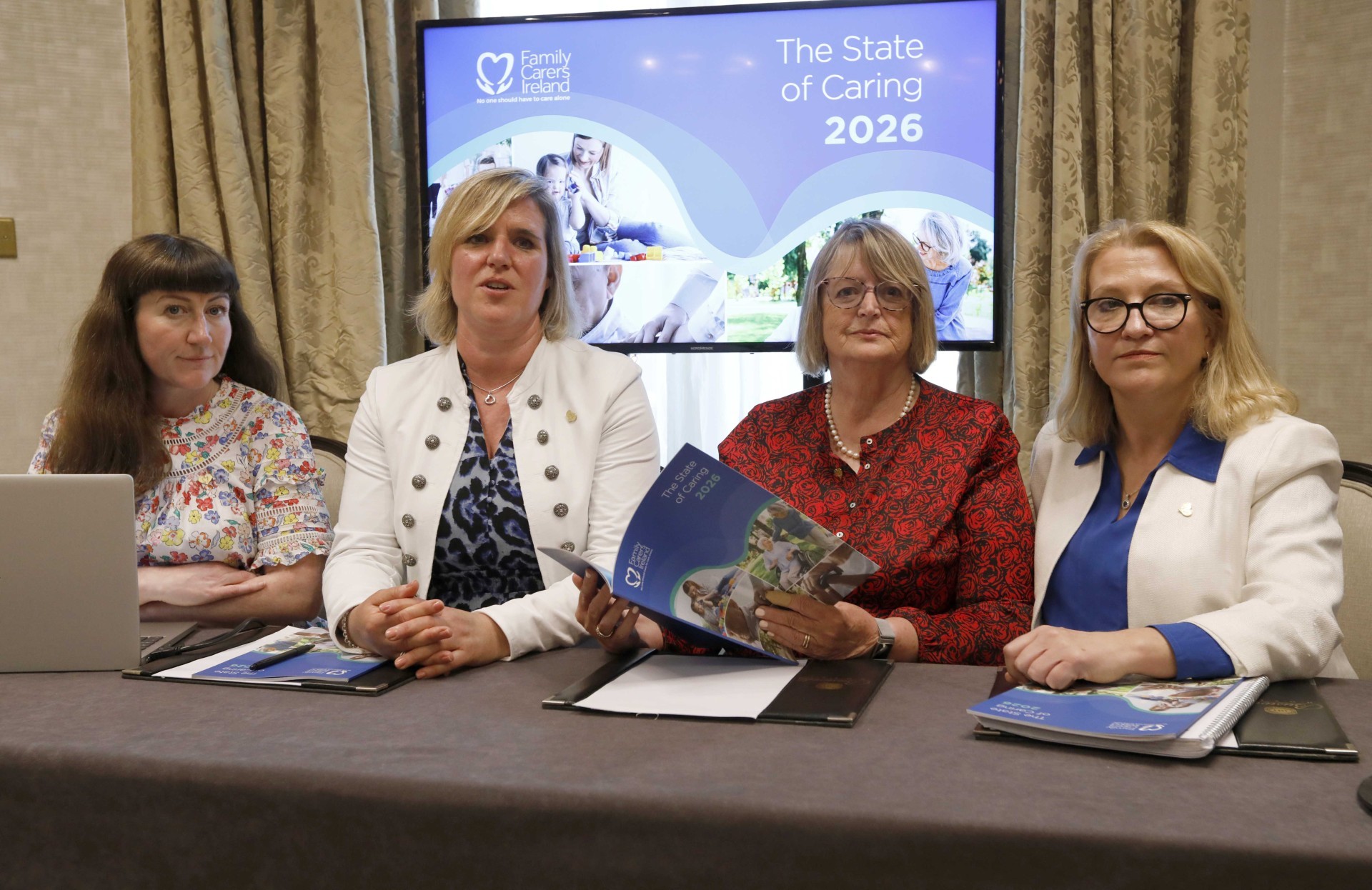
Family Carers Ireland has today warned that family carers are being pushed deeper into financial hardship and social isolation.
The charity’s new State of Caring 2026 report reveals that 71% are finding it difficult to make ends meet, while almost half, 48%, experience severe loneliness.
The report, based on responses from 2,930 current family carers caring for at least 4,042 children and adults, provides one of the most detailed pictures to date of family caring in Ireland.
It shows carers providing intensive care and support while facing lost income and higher costs linked to disability, chronic illness, heating, transport, medical equipment, therapies, and day-to-day care costs.
Among family carers experiencing acute financial difficulty, almost half, 49%, said they are cutting back on essentials such as food and heating.
More than three quarters, 76%, are reducing non-essential spending.
One family carer said, “I’m currently living down to the last cent every week.”
The report also finds that of those in acute financial distress, 29% are behind on utility bills, while 15% are falling into arrears with rent or mortgage payments.
One family carer said, “I haven’t made a bin or electricity payment since early December.”
As energy and fuel costs rise, only 18% of respondents receive Fuel Allowance.
Over a third of respondents, 35%, live in households with a total income of less than €30,000.
Among those under financial pressure, 8% report relying on food banks, 15% on charities such as St. Vincent de Paul, and 36% are borrowing money from family or friends.
At the same time, more than half, 55%, said they have paid privately for a product or service that should be publicly provided to support their caring role.
The report also points to significant gaps in formal support, with 69% saying the person they care for does not receive enough.
Almost two-thirds, 65%, reported being on a waiting list for publicly funded services such as therapies, wheelchairs or Assessments of Need, with 66% of those waiting more than a year.
The pressure is compounded by the intensity of caring.
Almost three quarters of respondents, 74%, provide more than 90 hours of care each week, while 67% care for more than 120 hours.
Despite this, 75% of family carers have never received respite.
The toll on their health and wellbeing is severe. 71% say their health has been negatively affected by their caring role, while 32% report bad or very bad mental health.
The report also finds that 48% of family carers experience severe loneliness, with 82% feeling that society has left them alone to manage caring responsibilities.
One carer said, “It’s 24/7. I’ve no one… I’m exhausted, mentally broken… I have to be everything for everyone.”
Another said, “I feel like a ghost, very unseen.”
The report calls for Government action that reflects the full reality of caring in Ireland today.
Its recommendations include abolishing the Carer’s Allowance means test, moving towards a new Family Carer Payment, increasing Carer’s Allowance and Carer’s Benefit to €325 per week, making carer payments tax exempt, introducing a Cost of Disability payment, extending Fuel Allowance to all Carer’s Allowance recipients and providing targeted support for households facing high care-related energy costs.
It also calls for flexible respite, a statutory home support scheme, action on the shortage of home care workers, shorter waits for Assessments of Need, therapies and specialist services, and financial relief for families forced to pay privately when public services are not available.
Crucially, it recommends a fully funded Carer Guarantee so that every family carer can access information, training and support, regardless of where they live, alongside recognition of family carers in health and wellbeing policy, inclusion in the National Loneliness Strategy, support to remain in work where appropriate, better transport supports and structured future planning for housing, care arrangements, financial security and decision making.
Catherine Rossiter, family carer for her twin children Aoife and Eoghan (12), said: “Caring for a loved one is emotionally, physically and psychologically challenging every day. Recent increases in the cost of living have placed a disproportionate financial pressure on carers.
“We struggle to manage our money and pay the extra bills that come with caring, such as additional heating costs to keep a home warm for our loved ones, or repaying loans for home adaptations.
“Telling us that we are “great” for caring for our loved ones does not translate into tangible supports, services or proper recognition.
“I often think my life is a test of human endurance.
“How much can I take as a carer before I break?
“What will happen to my young daughter and son then? The worry feels endless.”
Dr Nikki Dunne, Research Manager with Family Carers Ireland, said: “The results highlight not just the value of family care, but the State’s persistent failure to adequately fund and prioritise homecare and supports to family carers through a meaningful homecare scheme and a fully funded Carer Guarantee.
“Essential care is being delivered by family carers under conditions that are clearly not sustainable or fair.
“Government must now recognise care at home as a core pillar of health and social care and properly resource it accordingly.
“It also means ensuring income adequacy for family carers and funding and delivering on its promise to build and fund robust services for family carers under the Carer Guarantee.
“This would include accessible counselling, and emergency supports, reliable respite, services where, when and how they are needed, and practical day-to-day assistance to family carers wherever they may live.
“Without adequate investment, family care will continue to be treated as a low-cost substitute for proper public provision.
“The result is that family carers themselves bear the cost – through damaged health, severe social isolation, lost income, and diminished life opportunities – while the State avoids meeting its full responsibility.”