


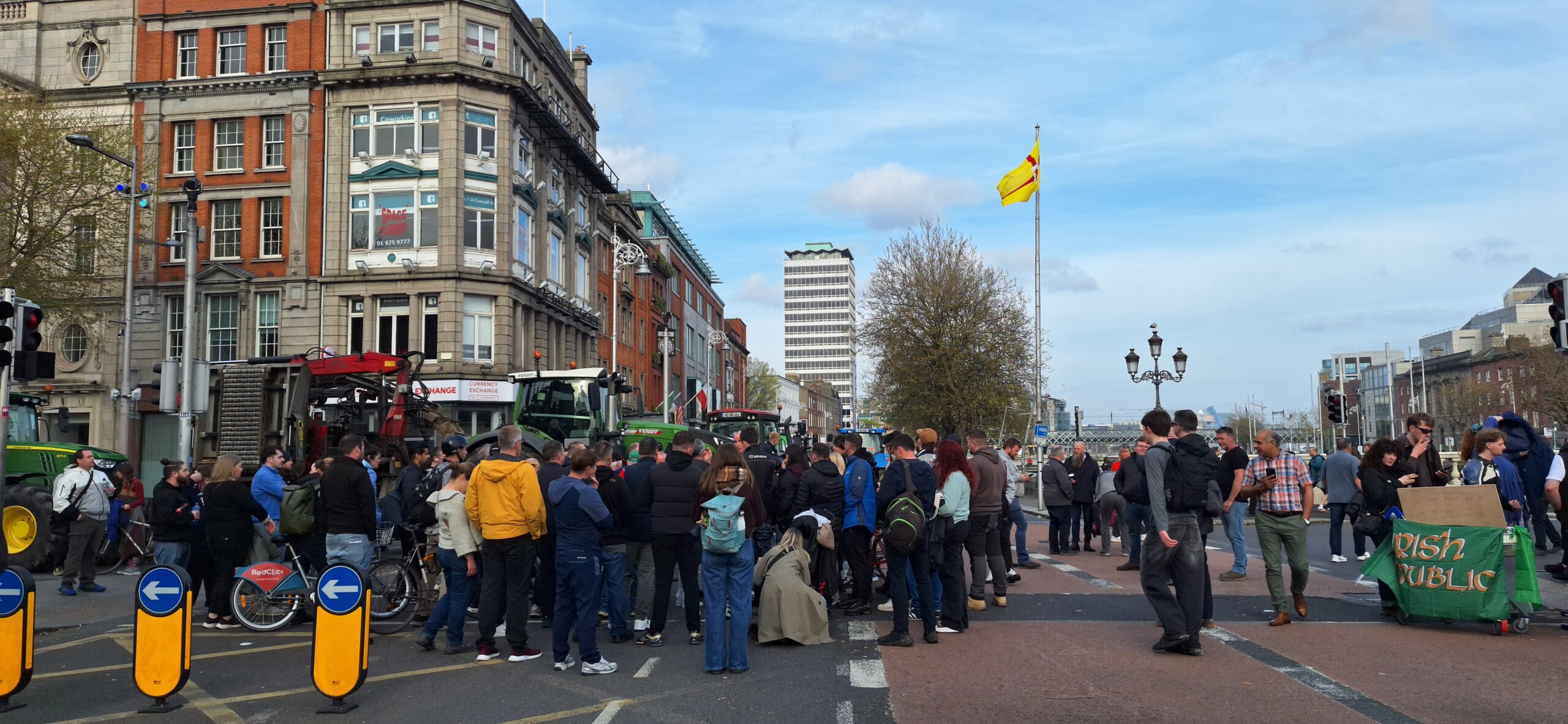
The Irish Council for Civil Liberties (ICCL) has said that the right to peaceful protest is not “an absolute right” and it can be “restricted or limited under certain circumstances.”
The organisation said “the right to peaceful protest is an important cornerstone of our democracy and should be protected. That right is not contingent on the popularity of the views expressed and democratic governments must demonstrate a level of tolerance for peaceful protest even if it causes disruption.”T
They noted, “protest is by its very nature disruptive. Disruption allows protesters to draw attention – including the attention of politicians – to their causes and concerns. Protests are a valid form of expressing discontent and it is important that political representatives listen to peaceful protesters and resist the temptation to dismiss them out of hand.”
They stated “however, the right to peaceful protest is not an absolute right and it can be restricted or limited under certain circumstances. The protections afforded to protest are weakened when issues arise related to, for example, public safety, people’s access to healthcare, a risk to life, public order, or incitement of violence or hatred. This is recognised in our Constitution, the European Convention on Human Rights and the International Covenant on Civil and Political Rights.”
“In practice, this requires a balancing of rights and a proportionality assessment, which must be dynamic as the facts of a protest can quickly change. Balancing rights in these situations is not an easy task and there is no clear line drawn for when a peaceful protest may exceed its authority.”
“The current fuel protests have mobilised thousands of people across the country, indicating that many people in Ireland are exercised by and under pressure due to cost-of-living issues. They do not appear to be a homogenous group. At the same time, there have been reports of missed medical appointments, forecourts running out of fuel and significant delays for emergency services responding to emergencies.”
The ICCL said “members of An Garda Síochána have a range of powers under the Criminal Justice (Public Order) Act 1994 and the Road Traffic Act 1961 to disperse protesters and deal with traffic obstructions. Acknowledging that large vehicles are more challenging to move than people, the potential deployment of the defence forces is a significant step and does raise serious concerns for the protection of peaceful protest in Ireland, and the relationship between the public and the state.”
“Human rights law provides a framework for how potential limitations on protests can be assessed to aid in the proportionality assessment. Any limitations or restrictions must be necessary, be as limited as possible, treat everyone equally and be provided for by law,” the ICCL stated.