


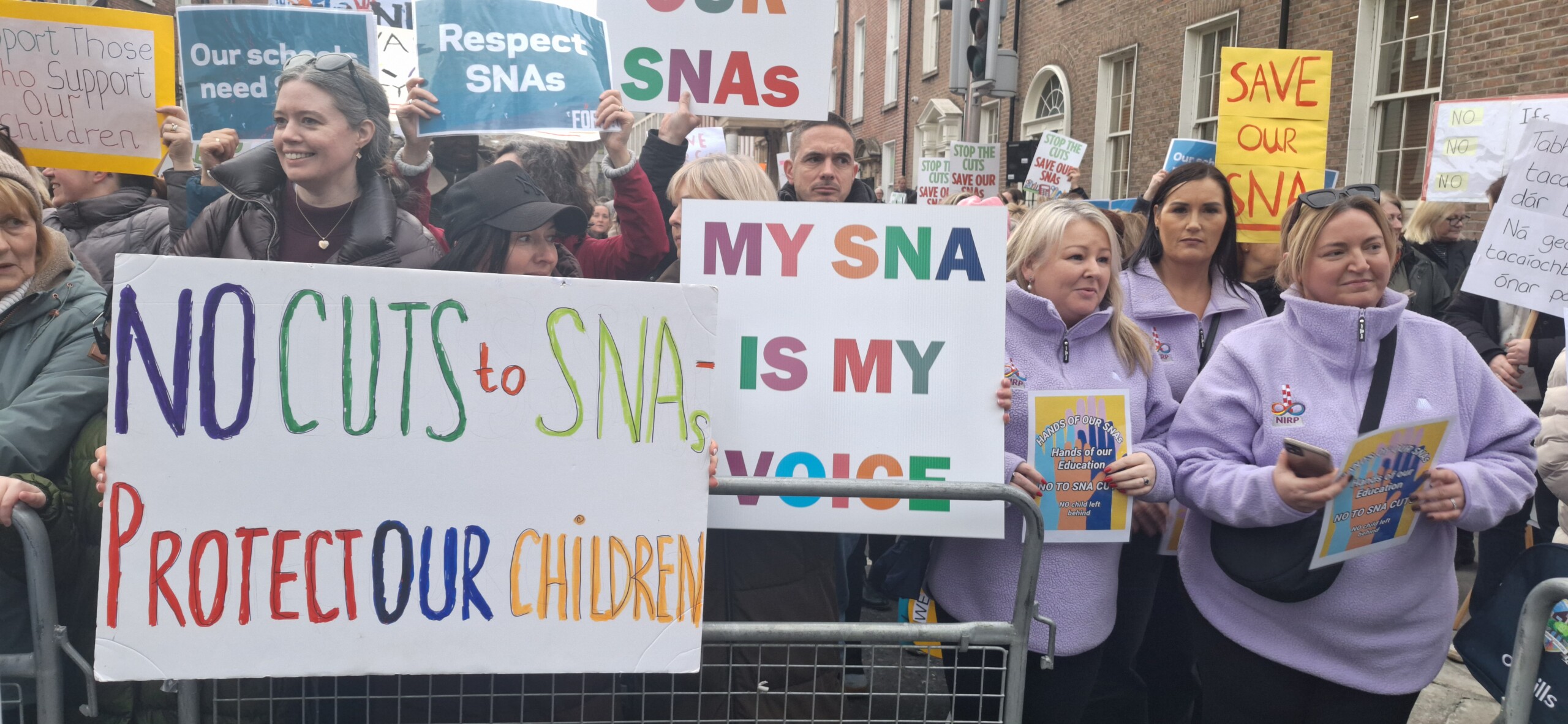
Dateline; February 25, Molesworth Street, Dublin 2.
The mid-term break was anything but for parents, teachers, and special needs assistants.
In a case of impeccable timing on the government’s part, letters were sent to schools informing them that SNAs were likely to have their roles cut, turning what should have been a well-earned break for the nation’s parents, teachers, principals and SNAs into a panic.
The rationale for cuts made little sense; in recent weeks, the government touted that Ireland’s GDP grew at a steady rate in 2025 and the Irish economy was among the most stable and fastest-growing in Europe.
Looking back into Ireland’s recent past reveals the answer to the government’s rationale, however.
This week in 2016 saw Ireland go to the polls and elect a Fine Gael/independents government with Fianna Fáil confidence and supply.
The 2016 election was historic as it saw the near-wipeout of the Labour Party, and the emergence of a potent anti-austerity electorate within Irish politics.
Some combination of Fianna Fáil and Fine Gael has run Ireland since then, which hints at the current crisis in Ireland’s special needs education; the 18 Cabinet members in Leinster House, just beside Molesworth Street, still subscribe to the austerity-era dogma.
Rain, which has recently dogged Dublin, managed to hold off for a hundreds-strong protest just outside Leinster House on Wednesday afternoon as a coalition of parents, children, teachers, SNAs and members of the opposition howled against proposed cuts that have left school children “terrified.”
Balbriggan, Tyrrelstown, Dalkey, The Liberties, Rathmines and Clontarf were all accounted for at the protest, a sign of how the issue cuts across postcode and class.
A government backtrack on the SNA issue wasn’t enough to deter the crowds, or indeed, the 25 other protests that took part across Ireland on Wednesday.
In a series of articles in 2025, the Northside and Southside People covered a number of protests outside the Department of Education and the Dáil, where parents, teachers and SNAs criticised the government for their apathetic approach towards special classes for children with additional needs.
A year later, People Before Profit councillor Conor Reddy, one of the protest organisers, said he “wasn’t really surprised” that the situation remains the same a year later.
The Dublin City Council member said it was encouraging to see such a strong reaction to the planned cuts, and said the onus was now on the government to engage with SNAs.
Reddy said that the government’s austerity mindset (which feeds into the civil service) is at fault for the current crisis in special education.
The Ballymun-Finglas councillor noted that special needs assistants are operating under rules and regulations that were drawn up in 2014; under the current circular, the definition of what constitutes an SNA does not line up with what an SNA does in 2026.
He noted that the current rulebook was designed in 2014, and that under the current legislation, SNAs are not recognised as “professionals” and are not accredited.
To Reddy’s argument, the government would argue that it is spending €19 million to ensure that there will be no cuts to the current SNA scheme, and Taoiseach Micheál Martin accused members of the opposition of “Doomsday talk.”
Martin’s words fell on deaf ears, and the sense of anger was palpable in the air outside Leinster House.
As the NHS has proven in the United Kingdom, merely throwing money at an issue doesn’t solve it; a system can be well-funded, but understaffed and under-resourced, which is precisely the issue facing the Irish education system.

Social Democrats councillor Jesslyn Henry also helped organise the protest, and addressed the protesters.
As well as her duties as a councillor for the Artane-Whitehall constituency, Henry also works as an SNA, and she told the crowd, “we cannot be forgotten.”
She said that there was a lack of transparency during the entire process,
Cathy, a teacher from the Southside, said she began teaching in 2017, and the Irish education system has “gone backwards” with each consecutive year.
A teacher of a class in Dalkey, Cathy said that the pandemic highlighted just how important SNAs were to neurodivergent children.
She said that neurodivergent children (such as children on the autism spectrum or who have conditions such as ADD, ADHD or dyslexia) need structure, routine and guidance, and the pandemic era took that from those children.
She mused that the government should have taken the pandemic era to reflect on the roles that an SNA plays within the Irish education system, but the opportunity was not taken.
Protest organiser Samantha O’Flanagan said that the government’s U-turn on the cuts were “not a resolution” and that children were “still in limbo” despite government assurances.
“Every child has a right to an education, and for children with additional needs, those rights are only possible with an SNA”, she told the protest.
She said that children with additional needs were being treated like “numbers on a spreadsheet,” and remarked that the government were “robbing Peter to pay Paul.”
Flanagan told the protesters that there was a “total disconnect” between the government and the special education crisis, and they are “not serious” about solving it.
“It (the proposed cuts) were allowed to happen by the people in that House over there”, O’Flanagan said, pointing to Leinster House, and said the whole affair was “an exercise in neglect.”
She stated that SNAS are “not extra and not optional.”
Niamh McDonald was also involved in the organisation of the protest, but said she was there, first and foremost, as a mother.
She criticised the government for what she calls a “cycle of chaos”; to McDonald’s point, following the protests outside the Department of Education and Dáil last year on the issue of special classes, the government vowed to engage and work to resolve the issue, only to repeat the very same mistakes a year later.
To McDonald, the government’s actions were less a mistake, and more a calculated decision.
The point of Ireland supposedly being a country of plenty with a healthy economy was reiterated time and time again by the speakers; McDonald referenced the government’s “rainy day fund,” and said what is a crisis in special education if not a rainy day?
McDonald told the crowd that the government were “on the run” following the public backlash, and said it was “crucial” that the opposition parties worked together on the issue.
TDs and Senators from the opposition (Sinn Féin, Social Democrats, Labour, People Before Profit, Greens and various independents) were either in the crowd or spoke at the protest, and the opposition parties have said they would be willing to work together and form a coalition to put pressure on the government parties.
From attending the protest, one gets the sense that there is a cross-party, cross-society movement brewing, and one that could give the government parties another headache.
While it is true to say that the opposition can (and already have) make hay over this issue, it is the words and actions of Ireland’s educators that will help this movement snowball and get results.