


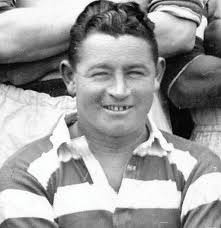
Today marks the anniversary of one of the greatest moments in Irish football history, when Ballybough’s Paddy Moore scored four goals against Belgium in Dalymount Park, the first player ever to hit four in a single World Cup match.
Long before that famous afternoon, Moore’s rise through the Dublin game had already marked him out as a player destined for something special.
He joined Shamrock Rovers from Richmond Rovers in 1928 aged just 18 and already one of the best young players in Dublin.
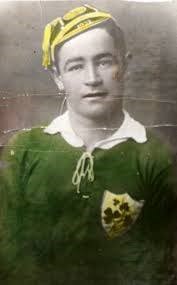

Many legends would go on to wear the famous green and white hoops in the decades that followed, but Moore was the first of them, the first local hero to truly capture the imagination of the city and carry its hopes beyond its streets.
His time at Shamrock Rovers would stretch across four separate spells and almost the entire 1930s.
Early on he was converted into a centre forward, a decision that would define his career.
In that new role he became one of the most feared attackers of his generation, winning every major honour in Irish club football, scoring the winning goal in the 1931 FAI Cup final and going on to represent his country nine times.
His reputation would carry him to England, Wales and Scotland, where he became a major figure at Aberdeen, scoring 47 goals in 74 games and equalling the club record for a double hat trick in 1932.
He was a footballer of rare, natural talent. Supporters adored him.
But there was another side to his life too.
Moore battled alcoholism for much of his adult years, and the illness would ultimately claim his life at the age of just 41.
In both brilliance and tragedy, there were echoes of another Irish genius who would follow decades later in George Best.
His first spell with Rovers was short but significant.
After The Hoops beat Bohemians to his signature near the end of the 1927-28 season, they moved quickly to turn him into a striker.
It proved to be an inspired decision. Moore settled into the role immediately, his goals helping the club lift the Free State Shield and marking him out as a player going places.
It did not take long for clubs across the Irish Sea to notice.
That summer he signed for Cardiff City, travelling over with another player of the same name, Paddy Moore from Mullingar Celtic.
The move should have been the beginning of something big, but it never quite took off. Opportunities were limited, chances were scarce, and after a frustrating season in the Welsh capital he moved on to Merthyr Town.
He played only five games there before another switch took him to Tranmere Rovers.
His time on Merseyside was also brief and, by the end of the summer of 1930, he was back in Dublin and back at Shamrock Rovers.
This second spell would bring stability and success.
In May 1931 he scored the goal that brought the FAI Cup to Milltown for a record third time in a row following a 1-0 victory over Dundalk in a replay.
The following season, he played a central role as the club secured the league and cup double in 1932.
Strong, sharp and instinctive in front of goal, he had become the focal point of the team and one of the most dangerous forwards in the country.
Once again, attention came from Britain.
This time it was Aberdeen who won the race to sign the Dubliner.
He arrived at Pittodrie as the direct replacement for Benny Yorston, who remains the club’s record goalscorer for a single season with 38 goals in 1929-30.
Yorston was one of several players released by the club following a betting scandal known as “The Great Mystery,” and Moore was brought in to help rebuild.
He made an immediate impact. In three seasons at Pittodrie he scored 47 goals in 74 games, winning over the Scottish support with his direct style and eye for goal.
His form was so impressive that newspapers at home began to follow his progress closely.
An article in the Irish Independent dated October 11, 1932, five days before a combined Ireland side faced England in Blackpool, spoke of how he was one of “only four Free State born men in the team” and praised the attention he was attracting in Scotland.
“It was fairly obvious Paddy Moore’s consistently good displays for Aberdeen would attract attention. Football critics in Scotland are going into ecstasies describing Paddy Moore’s play.”
Another writer captured the sense of excitement around him in even more colourful terms.
“Be thankful gentlemen for the entry of one Patrick Moore, an Irishman by birth, an Aberdeen player by choice and a football personality by nature,” the piece read.
By then he was already making his mark at international level. He had made his debut for the Free State in 1931, scoring in a 1-1 draw against Spain, and a year later he was selected on a combined Ireland team to face England, making him one of the few players to represent both Ireland and Northern Ireland.
Then came the day that would define his place in football history.

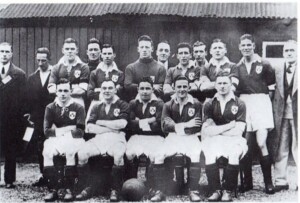
Ireland’s first World Cup team which drew with Belgium 4-4 on Feb 25th, 1934. Front row, l to r: Billy Kennedy, David Byrne, Paddy Moore, Tim O Keeffe, Jimmy Kelly. Back row: Miah Lynch, Joe Kendrick, Jim Foley, Tom Burke, Joe O Reilly, Peader Gaskins (capt) Coach Billy Lacey
On February 25, 1934, in Dalymount Park, Ireland faced Belgium in what was the country’s first ever World Cup qualifier. The ground was packed.
This was something new.
For the first time, Ireland were stepping onto the world stage.
On that day, Paddy Moore produced a performance that would never be forgotten.
He scored four goals.
Each one came with a different kind of finish, a different kind of instinct. Movement in the box, timing, composure.
A forward playing from the heart.
He became the first player ever to score four times in a World Cup match, a record that still stands as a unique piece of football history.
The Irish Press headline the following morning read: “PADDY MOORE SHARES THE HONOURS WITH BELGIUM.”
The match report tried to put into words what those in Dalymount had witnessed.
“Only Paddy Moore could have scored four goals, each of them was a masterstroke of precision and timing. The game was in the nature of a personal triumph for him.”
Back home, his name travelled quickly through the streets of Ballybough and beyond.
He had become more than just a footballer. He was a source of pride, a local lad who had taken on the world and left his mark.

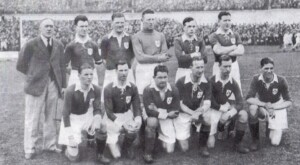
Paddy Moore pictured (centre of front row) with the Ireland team prior to their match v Holland in April 1934
Yet life away from Dublin never seemed to sit easily with him.
In old newspaper reports from the 1930s a picture emerges of a man pulled constantly between success and home.
In an interview with The Irish Press dated January 11, 1935, while still an Aberdeen player, Moore spoke openly about how much he missed Dublin.
“I’d be much happier if I was back playing in Dublin,” he said to the correspondent known only by the name “Socaro.”
He had still not returned to Scotland after playing in an international against Hungary in Dublin on December 16, almost four weeks earlier.
“Nothing would suit me better than to resume playing in the Free State,” he said.
“I put on weight very rapidly whenever I’m in Aberdeen, I feel a new man in Dublin and I find life at home much better for me.”
Within weeks of giving that interview, he was back at Shamrock Rovers once again. It was as if the pull of home was too strong to resist.
Moore had been a prolific scorer for Aberdeen and even equalled the club record for scoring six goals in one game for the Dons when he netted a double hat trick against Falkirk in 1932.
However, a new Armstrong-Mills strike partnership was blossoming at Pittodrie and he found himself surplus to requirements at Aberdeen.
A newspaper report from The Press & Journal, dated February 1, 1935 reported on his long awaited return to Aberdeen:
“Paddy Moore, Aberdeen’s Irish international centre-forward, who has been absent from Pittodrie since December 15, returned to Aberdeen last night from Ireland.
“He will report to Pittodrie this forenoon. and will in all probability turn out for the reserve team against Hearts A to-morrow.
“It will be recalled that Moore journeyed to Dublin to play for the Irish Free State against Hungary on December 16, and his failure to report back to Pittodrie created a sensation in football circles.
“All sorts of rumours were rife, prominent among them being one that Moore would not return to Aberdeen.
“A “Press and Journal” representative, who learned that Moore had crossed from Dublin on Wednesday, quickly spotted the Irishman as he descended from the 6.40 from Glasgow last night.
Moore was bareheaded and carried his football boots in a small attache case.
In an interview the player stated that his long absence from Pittodrie was due to a misunderstanding between himself and the club.”
The summer of 1935 saw a return to Shamrock Rovers and his final spell at the club brought more trophies and more memorable moments, but they were also years in which he was fighting a battle off the pitch.
Alcohol was tightening its grip.
Even so, he remained a presence on the field and a figure supporters loved.
He played on until 1942 and later had a short spell managing Stella Maris before emigrating to England.
He died there on July 24, 1951, aged just 41.
Decades later, the memories are still vivid for the one person who knew him simply as Dad.
When I originally researched this article back in 2014, I was lucky enough to speak with Paddy’s only son, Pat, who was just six years old when his father died.
“I have lovely memories of my Dad from when he used to take us out on the street to play football and when he used to take me to Miltown.
“I was 6 when he died in 1951 so the trips to watch Rovers play would have been in the late 40’s to very early 50’s.”
“He absolutely loved Rovers big time, he was always talking about them even though by that stage it had been over ten years since he’d played for them.
“They were his team here and he regularly went to watch them play whenever he could. When he’d get to the turnstile he’d just say ‘Paddy Moore’ and we’d be ushered in for free!”
“I remember well being at a game against Drums in 1950, that used to be a very big fixture, there was big rivalry between the two clubs then.
“I remember a lot about that game, I remember Benny Henderson, who was a big player for them, played because he had an almighty kick on him!

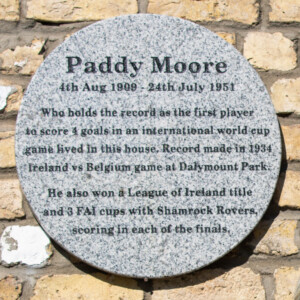
A plaque honouring Paddy on the wall of his family home ‘Meitheal’ on Clonliffe Avenue which was unveiled in April 2021
“Everyone loved my Dad, he was a great character, a bit of a rebel and a brilliant footballer.
“When I tell people that my Dad was the first person to score four goals in a World Cup match they don’t believe me, they think I’m making it up!
“But he was and that achievement can never be beaten, I’m proud of him and what he accomplished in what was quite a short career really by today’s standards.
“A bit of his talent must have rubbed off on me because I played as a centre forward myself up to semi professional level.
“He must have taught me something because I was always a good goal scorer.
“I still really love football and I’ve been a Wolves fan ever since I listened to their famous match against Moscow Dynamo on our radio in Cabra in 1955!”
Nearly a century on from that day in Dalymount, Paddy Moore remains a unique figure in Irish football history, the Ballybough man who scored four goals in a World Cup match and whose place in the record books is secure for all eternity.