


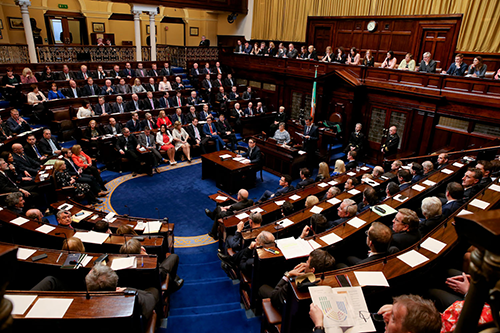
In the same week that Time Magazine named the “Architects of AI” as their Person Of The Year and Australia passed a ban on social media for under-16s, Northside TDs debated the issue of online safety.
Minister for Communications Patrick O’Donovan told the Dáil this week that regulation alone is not enough to address challenges associated with online safety, and said it requires a whole-of-society and a cross-party initiative to make online safer for the younger generations.
The Fine Gael Minister said that as Ireland will be hosting the Presidency of the European Union in the second half of 2026, it will coincide with the European Commission’s plans to introduce European-wide legislation surrounding online safety, and Ireland needs to bring its online safety code to European standards.
Fine Gael TD Grace Boland said, “like so many parents, I worry about what they (her children) will see before they are ready.”
“I worry about their confidence, mental health, and self-worth, and I worry about who might reach them when I cannot. My fears were confirmed recently when speaking to a children’s psychologist who told me that the impact of social media is now a dominant theme in her work.”
Boland relayed to the Dáil that the child psychologist is greeted with anxiety, isolation and pressure among young children as a result of social media.
“She implored me to do something,” she told the Dáil.
“Offline, we protect our children through law and shared responsibility; online, that same level of protection has not kept pace,” she said.
Boland said that banning technology wasn’t the silver bullet that other countries have claimed works, she said it was about “balance and responsibility.”
“Platforms have to play their part,” she said, with the debate coming in the wake of Twitter being fined €120 million under the Digital Services Act.
Dublin Bay North TD Naoise Ó Múiri said that a recent visit to the Dublin Rape Crisis Centre underlined the corrosive role of social media in modern society.
“The role that social media and online content play in inciting violence against women cannot be overstated,” the Fine Gael TD said.
“I had the opportunity to meet the Dublin Rape Crisis Centre last Thursday, and I heard first-hand about the central role that digital spaces now play in enabling and amplifying violence against women; acts that are effectively criminal acts in the real world can be depicted online without any fear of censure, penalty or punishment.”
Ó Múiri said, “it is just totally unacceptable. It is no surprise for anybody who spends time on Twitter or Facebook and sees firsthand the spaces where misogyny and sexual harassment thrive.”
Ó Múiri noted that “accounts that are anonymous spew horrific abuse at often vulnerable individuals across the globe with no consequences for what they do, not to mention the bots and AI accounts that are constantly there, monetising the suffering of others using abuse and exploitation as their tool to rack up all that advertising revenue.”
“Countries across the world are woefully unprepared for the challenges that lie before us and the pace at which technology is evolving.”
“We have a responsibility to protect our citizens from the real harms that the online world presents,” he said.
The European Commission found that the Elon Musk-owned social media platform, which has seen an exodus of users since the billionaire’s takeover in late 2022, was in breach of transparency rules for both advertisers and public data for researchers.
In response, Elon Musk banned the European Commission from advertising on the platform, a decision which Labour MEP Aodhán Ó Ríordáin called “petty.”
Furthermore, Musk claimed that the European Union itself was “undemocratic.”
The continued usage of Twitter by both government and opposition parties has been questioned by some.
Ó Ríordáin said, “Twitter was once my platform of choice, but the news this week is a reminder of why I deleted my account last year.”
“The EU’s fine is about basic consumer protection; it shows we stand up for our people, not the unchecked greed of reckless & childish tech billionaires,” the Labour MEP said.
“Twitter hands a megaphone to far-right poison & disinformation. It erodes our democracy, and it leaves our consumers and young people dangerously exposed to exploitation. Think twice before giving them your clicks,” he said.
Dublin Bay North TD Barry Heneghan, among the youngest members of the current Dáil, said “I was brought up with this” in relation to social media, and said that social media’s current function is to “keep people addicted and give them a dopamine hit.”
“I heard some other Deputies talking about what they have experienced online; if you cannot face criticism online, you definitely should not become a politician,” the independent TD remarked.
Heneghan said, “we are rewiring the next generation’s brains. Looking at the generation that is growing up, they are constantly comparing and looking. Social media is always about comparison. It is an online image.”
The independent TD said that he spoke to a parent in his constituency, and their son has had to quit using social media due to mental health struggles associated with social media bullying.
“That is something else we need to regulate,” he said.
Green leader Roderic O’Gorman said that social media has become a “doom-loop” of prioritising the “most extreme and most fringe” views that are “completely unmoored from fact, from reason and from any sense of perspective.”
“Today, the people who profit from this system have become the most powerful people in the world. They openly work to undermine our democratic foundations and their sales racket has been used by demagogues and charlatans to capture an entire political process,” he told the Dáil.
People Before Profit TD Paul Murphy questioned what, precisely, Fianna Fáil and Fine Gael were going to do about tech company regulation, and implied they were hesitant to rein in tech companies for fear of losing out on corporate taxation.
“We have had fine speeches from Fianna Fáil and Fine Gael TDs, but what is the government going to do about it? The answer so far is nothing.”
“It is a fine issue to make speeches about and to have concerns on, but when it comes to taking action and taking on the big tech companies, the Government has a record of inaction so far,” he said.
In May 2024, the government rejected a suggestion from Coimisiún na Meán, which would have legally compelled social media companies to turn off recommender algorithms by default.
“This one simple measure would have a massive impact. What happened to that recommendation? It was removed after lobbying by big tech companies,” Murphy said.