


The American comedian John Mulaney once joked that all dads spend their time reading about World War 2 as if they are cramming for a quiz show on the topic.
Over 80 years since the war ended, and with a threatened sequel in the works, the heroics of World War 2 continue to make for compelling cinema.
Pressure is the latest movie in the time-honoured tradition of “Dad Cinema.”
What constitutes “Dad Cinema” is a topic of debate among sociologists and film critics alike, but the broad scientific consensus agrees that a “Dad Movie” must be about a war of some kind (ideally World War 2), have a historical figure in it, be based on a true story, have at least one big movie star that they will recognise, and ideally, be less than 2 hours long.
Pressure passes the test with flying colours; the movie concerns the D-Day landings and the weather forecast surrounding it.
The hotdogging, name-dropping cowboy American meteorologist insists that the weather conditions are perfect for June 5.
The repressed, reserved, studious Scottish meteorologist insists that if the invasion goes ahead on that day, soldiers will be sent into their doom.
Of course, we know what happened (we’ve seen Saving Private Ryan; it wasn’t pretty), but that’s the subtle brilliance of Pressure; we know how the movie will end, but it still manages to wrangle tension out of the inevitable.
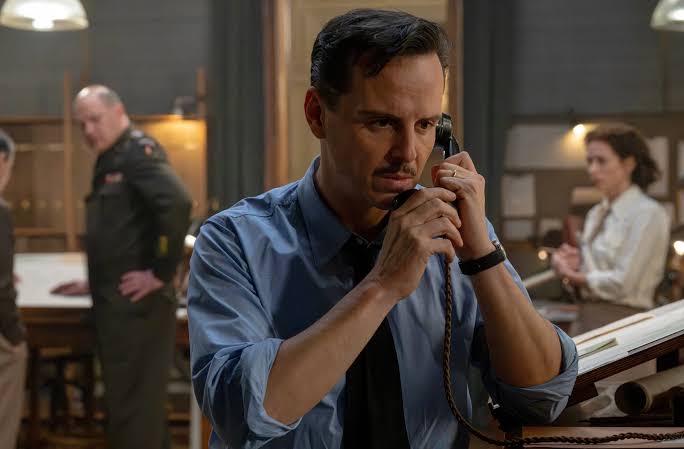
Leading the cast is Dublin’s own Andrew Scott, who plays the Scottish meteorologist James Stagg.
Stagg, the movie tells us, is Winston Churchill’s favourite meteorologist and has dispatched him to the war room ahead of the D-Day landings.
Scott is due for a big year (the Dubliner is Oscar-tipped for Elsinore, which is hitting our screens in late January), and his performance here is perfectly pitched for a World War 2 drama.
The real Stagg had a thin moustache; when you put one on Andrew Scott, it makes him look remarkably like David Niven.
Scott’s performance wouldn’t feel out of place in a Powell or Pressburger movie or a David Lean movie; he is the exact right calibre for the role.
The movie presents Stagg as being slightly prickly and laser-focused on his job at the expense of people skills; this creates a fun contrast with the American meteorologist Irving Krick, played by Chris Messina.
Krick later went on to be a pioneer of long-term weather forecasting and is insistent that predicting the weather is reliant on looking at past patterns and historical data.
Stagg insists that his data, which involves a more scientific process, is the answer.
In the middle of that is General Dwight Eisenhower, played by Brendan Fraser.
Then-general Eisenhower realises that the two men are at an impasse and tells them to work out their differences; therein lies the tension of the movie.
Eisenhower is still reeling from the failure of Operation Tiger, weeks earlier, and has a lot riding on the D-Day landings going right.
On paper, Brendan Fraser as Dwight Eisenhower doesn’t make a whole lot of sense, but the minute you see him in full uniform, wide shoulders taking up the screen, you realise it is a great bit of casting.
Fraser’s casting as Eisenhower is slightly generous to the real man; Fraser is 6”3 to Eisenhower’s 5”10.
Fraser’s height does create some great visual humour, where he towers over Scott, and Scott manages to find humour in being intimidated by Fraser.
Post-Oscar, Fraser has turned into one of cinema’s great shouters, as shown in films like Killers Of The Flower Moon, and this movie gives him plenty to shout about.
Scott and Fraser are the two big stars of the movie, but the supporting cast is equally as impressive.
Banshees Of Inisherin star Kerry Condon plays Kay Summersby, the Irish woman who worked her way up from chauffeur to become Eisenhower’s private secretary.
A fascinating and forgotten historical figure (who should be the focus of her own movie), Condon manages to add some warmth to a role that is a bit thin on the page.
Eisenhower is haunted by the failure of Operation Tiger and wants D-Day to go right to atone for it; that adds another layer to the story we already know everything about.
We know that D-Day goes right, but the movie (and the play that it is based on) manages to mine pathos out of a historical event that is already very well-covered.
Rounding out the cast is Homeland star Damian Lewis as the renowned British general Bernard Montgomery.
Lewis has more than a passing resemblance to the man himself, and plays the blustering British general role perfectly.
The key scene of the movie, where Stagg tells the room of American and British generals that the D-Day landing should not go ahead on June 5, is excellently directed and acted, and the scene is complemented by Lewis’ performance.
Montgomery regales the room with his exploits in North Africa, and says that in that particular theatre of war, the weather reports from the Americans never let him down, which gets a smile from the American side of the room.
Stagg then informs them that the weather system in North Africa is more stable and easily predictable; they are trying to contend with weather in the North Atlantic.
Apart from the strong Irish contingent in the cast, Ireland’s role in the story isn’t overlooked.
The movie goes out of its way to mention Blacksod Bay and the crucial role of Maureen Flavin Sweeney.
The Mayo woman’s analysis of the forming storms in the North Atlantic was crucial in the prediction of the storm, and it is heartening to see a big Hollywood movie like this give her a well-earned shoutout.
At just over 100 minutes, Pressure packs a lot in (it may not have Saving Private Ryan’s budget, but it has a spirited attempt at a D-Day landing scene), from quiet character drama to big, shouty arguments.
A nice subtle detail is the cigarette smoke and cups of tea that are present in nearly every scene.
A great historical drama has some historical flourishes (look out for all the men wearing suspenders, for example), and Pressure does a nice job of capturing what that particular, stressful weekend in June 1944 must have felt like.
All great historical movies will send the viewer down a Wikipedia rabbit hole, and on those grounds, Pressure does a fantastic job.
Pressure is a solid, workmanlike entry into the World War 2 genre; it doesn’t have the grandeur of The Longest Day or the swashbuckling feel of Kelly’s Heroes, but it doesn’t need to have the big battle scenes to still be a good movie.
As this movie tells us, the men and women who worked away behind the scenes were just as crucial to the outcome of the war as the men who stormed the beaches of Normandy.
For fans of historical process movies like Quiz Show, Apollo 13 or The Day Of The Jackal, this is the perfect film to go see; heaven knows we don’t get nearly enough of these movies in cinemas these days.