


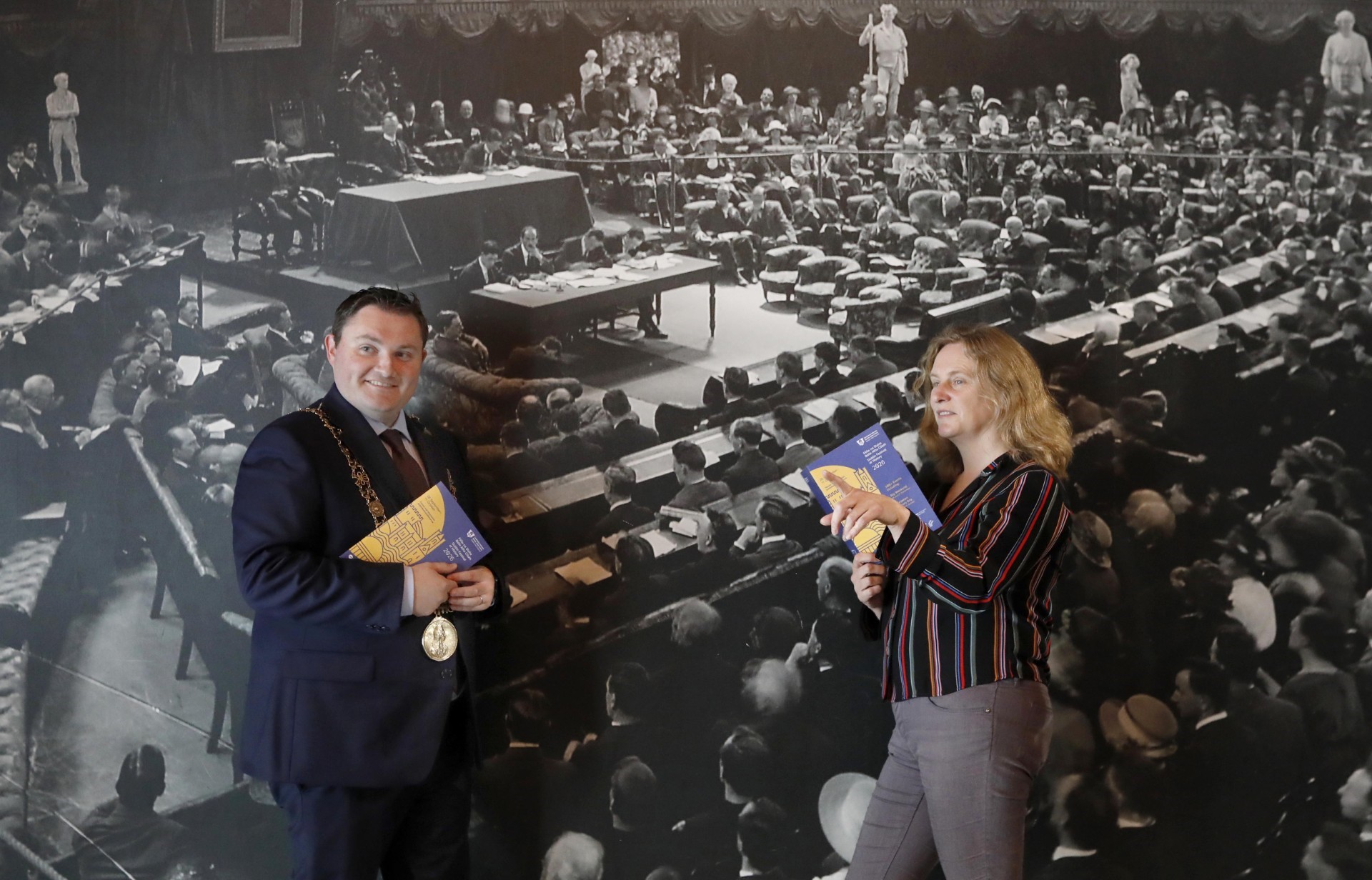
Dublin Festival of History has announced its programme of events for 2026, taking place from 26th September to 11th October at various venues across Dublin.
Now in its fourteenth year, the Dublin Festival of History continues to bring fresh perspectives on history, attracting best-selling Irish and international historians to Dublin for a high-profile programme of history and debate.
The festival opens with The Big Weekend — a packed two-day programme of talks, debates and panel discussions — and will close on Sunday 11 October with a special European History Day at the Royal Irish Academy of Music.
The Big Weekend – Saturday 26 September
This year, for one day only on Saturday 26 September, the Big Weekend will come to you! Taking place at Central Library, Coolock and Cabra Libraries, Pearse Street Library, and Richmond Barracks, Inchicore, the programme reflects the extraordinary variety of Dublin’s history. At Cabra Library, a panel of historians from Bohemians, Shelbourne, Shamrock Rovers and St Patrick’s Athletic will explore the history of Dublin’s great football clubs and their place in the social fabric of the city. At Richmond Barracks, Sonja Tiernan will discuss the life of poet, pacifist and political activist Eva Gore-Booth, while at Central Library Aoife McCloughlin will explore the story of two icons of Dublin public art – the Anna Livia Fountain and Molly Malone statue – both unveiled during the Dublin Millennium in 1988.
Other Saturday events include Gerard Shannon on Rory O’Connor, one of the most important IRA leaders of the revolutionary period; Connal Parr on the Irish Anti-Apartheid Movement; Kevin Rafter on Magill, Vincent Browne and Ireland in the 1980s; and the fast-paced Dublin History Dash, in which Dublin City Council’s Historians-in-Residence will uncover stories of the city through individual objects and documents.
The Big Weekend – Sunday 27 September
On Sunday 27 September we return to the city centre, with a full day of talks featuring the best of national and international talent, at the Round Room in the Mansion House. Bestselling author James Hawes will join us to talk about his runaway non-fiction success of the year, The Shortest History of Ireland, while Antonia Senior tells the story of the Cambridge Five and their decades of espionage for the Soviet Union.
Dublin and Manchester United legend Kevin Moran reflects back on his career and a different sporting era with Roy Curtis. Best-selling historian Katja Hoyer examines the Weimar Republic, and the lasting cultural and political impacts it had.
The programme also marks some significant centenaries. A panel featuring Cormac Moore, Margaret Ward and David McCullagh, chaired by Ronan McGreevy, will examine a century of Fianna Fáil, founded in 1926, while historian Aoife Bhreatnach looks back at the establishment of the Committee on Evil Literature and the censorship culture that followed.
The centenary of the first census of the Irish Free State will also be explored in The Story of Us: Dublin in the 1926 Census. With the release of the 1926 Census returns by the National Archives, Dr John Gibney, Prof. Terence Dooley, Dr Ruth McManus and Dr Ida Milne will explore what those records reveal about the people and communities of Dublin a century ago.
European History Day – Sunday 11 October
As part of Ireland’s Presidency of the Council of the European Union, this year’s festival will feature a European History Day, exploring the people, events and ideas that have shaped Europe across the centuries. Taking place at the Royal Irish Academy of Music on Sunday 11 October, the line-up includes Catharine Edwards on Cicero and the end of the Roman Republic, Rory Carroll on Roger Casement, Germany and Easter 1916, and Helen Graham on the Spanish Civil War as a national, European and global conflict.
The Dublin Festival of History works with over 90 cultural and community partners, to deliver over 300 free events taking place in venues right across Dublin. The programme offers opportunities for people of all ages and interests to explore history, from the intensely local to the international. Content in the Irish language includes a tour of Dublin with 1798 expert Fergus Whelan, and a talk exploring the life of the radical author Máirtín Ó Cadhain. There is also much for children and young people, including workshops, tours and talks.
Speaking at the launch, the Lord Mayor of Dublin Daryl Barron said: “The Dublin Festival of History reminds us that history is not something that exists only in books or museums – it is all around us, in our streets, our neighbourhoods and our communities. I am particularly pleased that this year’s Big Weekend is bringing events directly into communities across the city, giving Dubliners even more opportunities to discover the people and stories that have shaped the place in which we live.”
Also speaking at the launch, Iseult Dunne, Chief Executive of Dublin City Council Culture Company, said: “The Culture Company is delighted to partner with Dublin City Libraries once again to bring history into communities across Dublin. The festival creates opportunities for people to encounter history in accessible, engaging and sometimes unexpected ways, and this year’s programme shows just how many stories can be found in the places and communities around us. We are again extremely pleased at the range of partner venues, geographical locations and the breath of the offer of this 3 week free festival of all things History. ”
Brendan Teeling, Acting City Librarian, said: “Public libraries are places where people can explore ideas, discover stories and deepen their understanding of the world around them, and the Dublin Festival of History is a wonderful expression of that role. This year’s programme ranges from the intensely local to major events in Irish and international history, and whether you are already passionate about history or simply curious to know more about your city, there will be something here for you.”
The Dublin Festival of History is an annual free festival, brought to you by Dublin City Council, and organised by Dublin City Libraries, in partnership with Dublin City Council Culture Company.
To see the complete programme of events, visit dublinfestivalofhistory.ie/events All events are free, but advance booking is advised.