


Certain directors make their names by being the master of one specific thing.
Alfred Hitchcock was the master of suspense, David Lean could make a historical epic better than anyone and Milos Forman loved to poke holes in societal systems and norms.
In the modern day, Dublin man John Carney is in the same category of directors who are brilliant at one specific kind of film.
Carney makes music-based films better than any director working today, and his track record speaks for itself; Once, Begin Again, and Sing Street are glittering examples of how music and film can produce a fruitful marriage.
The throughline in Carney’s films is that even when times get tough, you can fall back on the power of music.
The Dubliner is back with his latest music-based film, Power Ballad, and Carney continues his streak of humane movies about the relationship people have to music.
In Power Ballad, Paul Rudd stars as an American musician who lives in Ireland with his wife and daughter, and makes his living performing in a wedding band.
As the film tells us, playing in a wedding band means you are a human jukebox, and there is very little room for indulging in rock star fantasies; “shut up and play the hits,” as the 2012 documentary on LCD Soundsystem once told us.
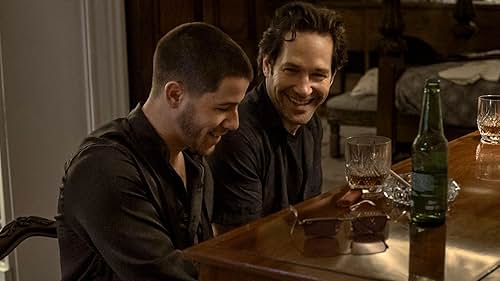
After one wedding gig, Rudd strikes up a conversation with an American pop star played by Nick Jonas, and the pair spend the night writing songs together.
In this early scene, Carney’s ear for dialogue and the bridges that music builds between people shine through.
Rudd’s character is a former American musician with dreams of rock stardom, who left it all behind after he settled down with an Irish woman, and Jonas’ character is a former boyband member who is desperately trying to sound like a man when the world still perceives him as a boy.
The casting of Rudd and Jonas works fantastically; Rudd’s charm (and seeming inability to age) and Jonas’ chip on his shoulder about not being taken seriously make for a potent mix.
Jonas’ character talks about still being judged on his boyband days and wants to be treated like a real musician (sound familiar?), whereas Rudd’s character has struggled to attain mainstream success.
The pair workshop a song that ends up changing both of their lives; John Carney’s movies are known for their great original music (Once famously won the Oscar for Best Original Song, and Sing Street had a fantastic soundtrack), and the song at the centre of Power Ballad is a strange one.
In the context of the film, the titular Power Ballad is a sugary, Coldplay-esque song that you would realistically believe would be played in stadiums, over shopping centre sound systems, requested at weddings or played non-stop on the radio.
The song is hardly on the level of Falling Slowly or Drive It Like You Stole It, but that might also be the point; the song is totally believable as an insipid top 40 ballad and wouldn’t sound out of place on 2FM.
After promising to keep in touch, Jonas’ character ghosts Rudd, and a few months later, Rudd hears the song that they wrote together play in Dundrum Shopping Centre as the song becomes a major global hit.
Rudd’s character tries to get his slice of the pie and prove that he wrote the song.
Carney understands that the best part of any music movie is the challenge to get to the top of the mountain.
The very best Coen Brothers movie (Inside Llewyn Davis) gets a lot of mileage out of someone being clearly talented, but they are their own worst enemy.
In that film, the Coens write Llewyn Davis as someone who has been given the winning lottery ticket but has no idea how to cash it in; Paul Rudd’s character in Power Ballad has a similar issue, and it makes for compelling viewing.
Rudd’s character tries to prove to anyone who will listen that he wrote the song that has become a global smash hit, but he also has no proof that he wrote it.
The escalating tension – having to perform the song with the wedding band, hearing it on the radio, all while the bills keep piling up – causes Rudd to snap and burn all his bridges with the people in his life.
The best scenes of the movie are when Rudd is clearly at his wits’ end, seeing the song become a massive global hit, but he isn’t seeing a cent of the proceeds because he can’t prove he wrote the song.

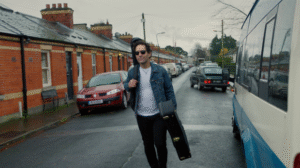
Up the parish! Paul Rudd walks the streets of Dublin in Power Ballad
The 2019 Danny Boyle film Yesterday has something of a similar premise; in that movie, a young musician is the only person in the world who remembers the music of The Beatles, and the best parts of that movie are when he is trying to play the hits to a disinterested audience.
When Power Ballad plays in that space, about how the creative process is richly rewarding on a spiritual level, but it doesn’t pay, it reminds people why Carney is the best at what he does.
As the film goes “more American”, which is to say, too sentimental, it loses a lot of the spark.
Once and Sing Street were distinctly Dublin movies in their texture and behaviour; while Dublin is a character in this movie, it feels almost incidental at times, it’s not the main ingredient like those movies, it’s only seasoning now.
If Carney leaned a small bit more into the Dublin angle, the film would have matched up to his earlier work.
The film is split roughly 55-45 in favour of drama over comedy, and the comedy bits of the film are passable.
Paul Rudd’s bandmates give the film a certain Je Ne Sais Dub, but the big appeal for Dubliners is seeing our fair city on the big screen.
Seeing Paul Rudd stroll around Dublin’s streets – Crumlin will turn out in droves to see their patch of Dublin on the big screen – lends the film a real charm, and when the film heads Stateside, the air goes out of the balloon.
As for the economics; is Power Ballad worth seeing in the cinema?
The thrill of seeing Dublin on the big screen is probably worth the price of admission for the sheer novelty of it, and the film sounds good, but it will likely play just as well at home as it would on a cinema screen.
Power Ballad aims for profound and heartfelt (like Bruce Springsteen) but it ends up somewhere around Coldplay (safe, no real risks taken).
There’s enough of a scrappy, never-say-die Dub attitude that makes Power Ballad stand out from the pack, but it’s more of an album track than a lead single.