


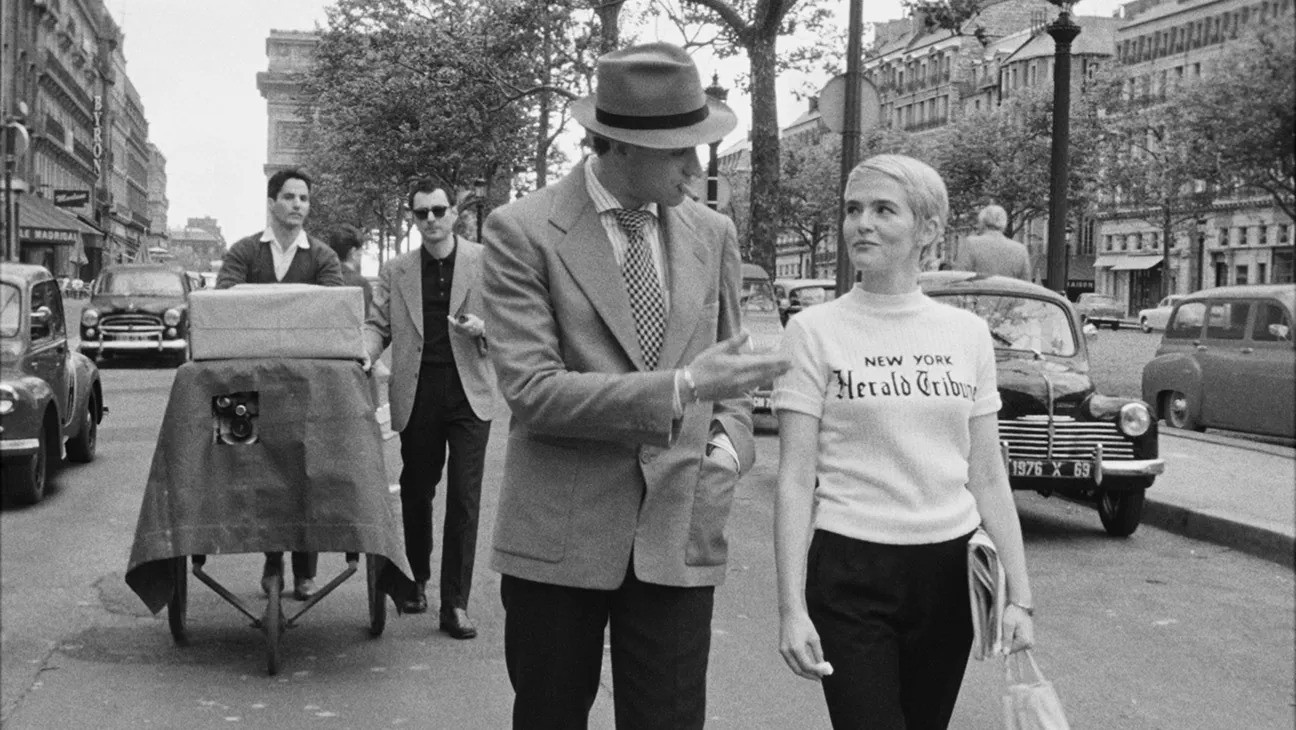
Great news for people who frequent the IFI and read Sight and Sound every month – there’s finally a film that unapologetically appeals to us.
Bad news for people who think Jean-Luc Godard is a French fashion designer and don’t know their Breathless’ from their Weekends’ – you’re out of luck with this week’s review.
Nouvelle Vague is the latest film from American master Richard Linklater, and documents the making of Godard’s 1960 classic, Breathless, along with the artistic community that surrounded it.
For people who took at least one film class in college or are up on their cinema in any way, Breathless is the one film you watch and realise you “get” foreign language cinema.
Breathless, itself, was a true revolutionary film which played a large part in establishing what later became known as the French New Wave (or to give it the proper title, Nouvelle Vague), and Linklater manages to capture the zest and zeal that makes the film so special.
Nouvelle Vague is a film for cinephiles, by cinephiles, and makes no apologies for it; if your idea of a comedy involves Ryan Reynolds, look elsewhere.
Linklater treats Roberto Rossellini giving a stirring speech to the staff of Cahiers De Cinema with the same grace as David Lean shooting Peter O’Toole in Lawrence Of Arabia.
Every member of the French New Wave is accounted for, and it is amusing that Linklater gives them their own credit like they’re a member of the Avengers.
For people who want to see Agnés Varda and Jean Cocteau in the same film, your prayers have been answered.
Linklater’s films are masterful in conjuring “hang-out” vibes, where not much plot happens, and the plot is advanced by people just talking; this film is no exception.
Shot entirely in black and white and with the dialogue largely in French, Nouvelle Vague will most definitely frustrate a casual viewer, but is catnip for film fans.
Films about filmmaking are basically their own genre at this stage, and the best ones focus on the people at the heart of it; this is where Nouvelle Vague stands out.
Tim Burton’s finest hour came with Ed Wood in 1994, and the strength of that film was realising that while yes, Ed Wood himself was an interesting and fascinating character, it was the people around him that made him tick.
In a similar vein, Nouvelle Vague is about the power of the arts and how people make their best art when they are surrounded by people whom they trust.
For anyone who has ever picked up a camera – be it a DSLR, a smartphone, a webcam – and wanted to make a film of their own, Nouvelle Vague is the ultimate tribute to the dreamers.
Yes, Nouvelle Vague feels a bit formless and shaggy in places, but that’s what the best Linklater films do; you don’t go into a Linklater film expecting a plot to go from A to B to C, you know what journey you’re going on when you buy the ticket.
Nouvelle Vague is the kind of film that would play exceptionally well at a 2pm Tuesday afternoon setting, full of film students and retirees alike (or as this critic calls it, university).
Linklater has a habit of discovering future stars (Matthew McConaughey, Renée Zellweger, Glen Powell), and he’s pulled the same trick again with total unknown Guillaume Marbeck.
Prior to this film, Marbeck had exactly three credits to his name on IMDB, yet he was chosen by Linklater to bring the fiery, sardonic Godard to life.
Cinephiles have this image of Godard in their head as the man who always wears sunglasses, a cigarette always hanging out of his mouth, and Marbeck vanishes into the role.
Marbeck does a much better job of selling the idea of a ’60s iconoclast than Timothée Chalamet did in A Complete Unknown; it would not be surprising if Marbeck goes on to become an in-demand actor in Hollywood after this (or, in the Godard style, treat the system with contempt and just make whatever appeals to him).
Godard himself was the closest that cinema had to an Eric Cantona figure; mercurial, spoke in riddles, but effortlessly cool.
Despite the many hours of documentary footage about the man, everyone thinks they have an idea of how Godard operated, but Marbeck does an incredible job of putting his own stamp on the icon; even if he never acted again, this would still be a performance we’ll talk about years from now.
The star of Breathless, Jean-Paul Belmondo, was known for his pudgy, boxer’s nose, and once again, the casting department seems to have found a clone of the man himself.
A running joke among younger film fans is judging if actors in historical films look like they have seen an iPhone before – credit where it’s due to the casting department on this movie, there’s nary an iPhone case in sight.
Zoey Deutch is the only recognisable name and face in the cast, and she is given the unenviable task of playing Jean Seberg.
Deutch has been tapped as a “rising star” for the best part of a decade now, but this is the film where she fully comes into her own.
Deutch has a real sense of old school glamour to her (in case you can’t place her, she is Lea Thompson’s daughter, which is why she looks so familiar), and those qualities make her perfect for Seberg.
Playing someone as well-documented as Seberg is a daunting task, but Deutch does a fantastic job of putting her own spin on it.
Seberg herself had a personality that was 60% effervescent, 40% brittle, and Deutch plays that balance very well.
If Nouvelle Vague runs into a problem, it’s Linklater’s decision to gloss over or skip by potentially dramatic production tidbits from Breathless.
For a film that was shot in around 20 days, guerrilla style and with not much money, Nouvelle Vague doesn’t really take the chance to explore the ingenuity of Godard and his crew.
Aside from Seberg being annoyed with Godard’s directing methods, there isn’t much in the way of conflict in this movie, which sort of begs the question of what the point of the entire endeavour is.
We already answered our own question – it’s about the communities we find and share art with – but that’s more of an abstract, bigger picture idea than something clean and succinct.
Then again, the French New Wave was never about offering clean and easy solutions; the entire movement was a reaction to what French critics perceived as Hollywood bloat and on those merits, Nouvelle Vague captures the spirit of the movement, over 60 years later.
For people who know the hits of Godard’s filmography or know the iconography of Breathless (the jump cuts, the famous ending, the interview scene), Nouvelle Vague is like a warm bath that invites viewers to sink in.
For casual punters who think the film sounds like the name of a perfume, steer clear.